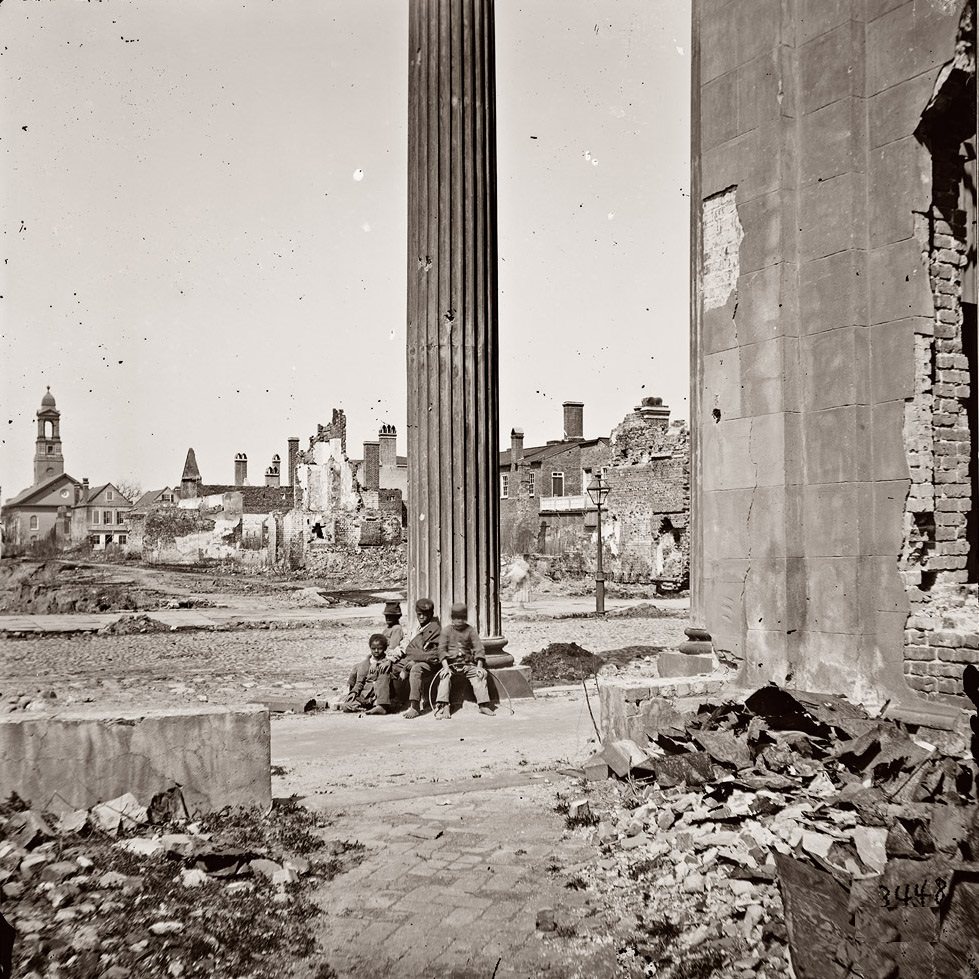
Framed by the porch of Charleston’s Circular Church at 150 Meeting Street, the view opens onto a scarred cityscape in April 1865, where broken walls and roofless shells stretch across the middle distance. A massive column rises in the foreground like a surviving monument, while piles of brick and splintered masonry spill across the ground to the right, emphasizing how close the destruction sits to the viewer’s feet. Beyond the rubble, chimneys and partial facades still stand, creating a jagged skyline that hints at neighborhoods abruptly halted mid-life.
Near the base of the column, a small group sits and lingers in the shade, their presence quietly anchoring the scene in human scale amid the wreckage. The street surface appears uneven and muddy, with scattered debris and what looks like temporary pathways cut through the ruins. In the background, intact structures—along with a distant church-like tower—underscore the uneven pattern of damage, where some buildings endured while others collapsed into open air.
As a Civil War–era Charleston photograph, this composition works both as documentation and as a stark piece of storytelling: the porch becomes a threshold between sanctuary and ruin. The Circular Church setting, paired with the visible devastation across Meeting Street, makes the image especially compelling for readers searching for Charleston history, Civil War ruins, and architectural loss and survival. Even without naming individual lives, the photograph preserves a moment of pause in a city remaking itself from shattered brick and standing columns.