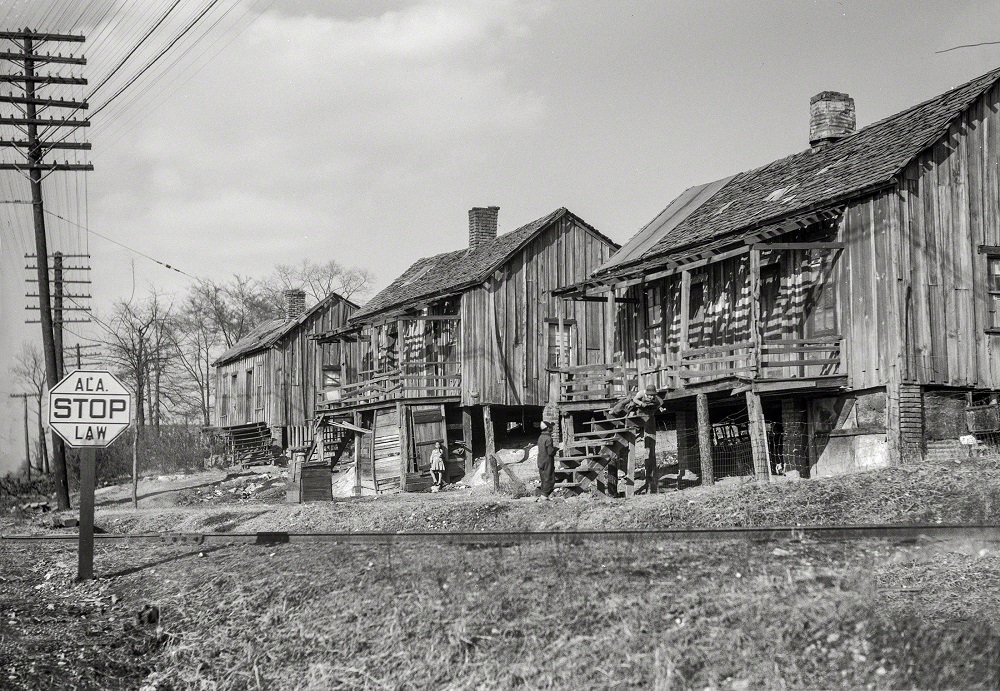
Weathered wooden cottages line a rough roadside in Birmingham, Alabama, their porch rails and patched roofs hinting at years of hard use. Power poles and a tangle of wires march into the distance, while a roadside sign reading “ALA. STOP LAW” anchors the scene in everyday regulation and routine. Set close to what appear to be rail tracks in the foreground, the houses sit on raised foundations, with steps and narrow porches creating small stages for daily life.
Laundry hangs from porch lines and a few figures linger near the steps, turning the miners’ housing into more than just architecture—it’s a lived-in neighborhood shaped by work and necessity. The uneven boards, improvised supports, and spare yards suggest a company-town practicality, where durability mattered more than comfort. Even without seeing the mines themselves, the built environment speaks clearly to industrial Birmingham and the working-class families who kept its coal economy running.
Taken in 1937, this photograph offers a grounded look at Depression-era housing conditions in a Southern industrial city, capturing the texture of a community on the margins of prosperity. Details like the sagging porches, bare trees, and stripped earth convey a landscape worn by labor and time. For readers interested in Birmingham history, coal mining communities, or the social fabric of the 1930s, the image preserves a candid snapshot of “Places & People” at street level.