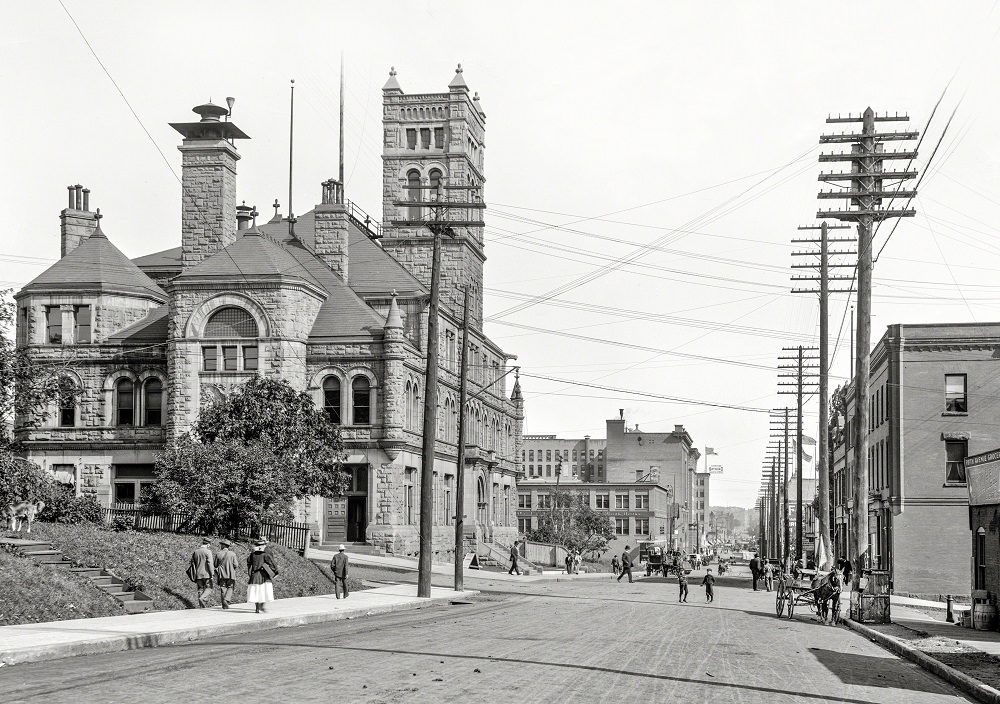
Stonework and civic pride dominate the view at the corner of the Post Office and First Street in Duluth, a 1910 streetscape anchored by a substantial public building with towers, arched windows, and a steep roofline. The photograph’s crisp perspective pulls the eye down the broad roadway, where the official architecture gives way to a line of downtown blocks receding into the distance. Overhead, a web of utility wires hints at a city wired for modern communication even as it still wore its grand, masonry face.
Along the sidewalks, small groups of pedestrians cluster and drift, their dark coats and hats lending scale to the scene and reminding us that the post office was as much a gathering point as a government service. The street itself feels comparatively open, with just a few conveyances visible and plenty of room for everyday movement, errands, and conversation. Details like the raised verge near the building and the gradual slope of the road help place this corner within Duluth’s distinctive urban terrain.
For anyone tracing Duluth history, early 20th-century architecture, or the evolution of American downtowns, this image offers a grounded snapshot of how places and people met at the city’s civic heart. It reflects an era when public institutions projected permanence, while commerce and daily life flowed past their doors. As a historical photo of Duluth’s post office on First Street, it invites close looking—at the built environment, the street life, and the infrastructure that quietly stitched the city together.