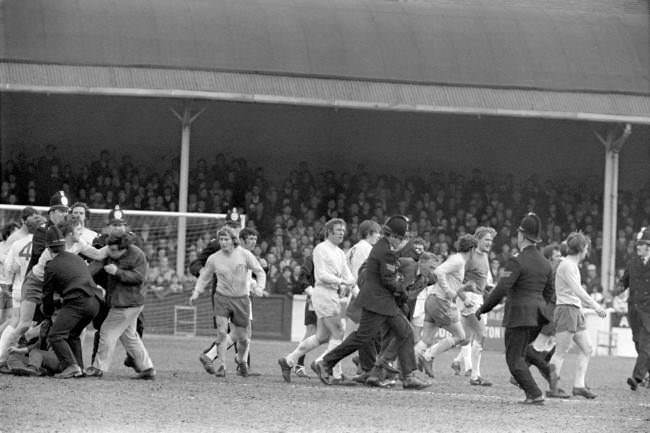
Tension spills across the pitch in this 1970s Leeds United scene, where policemen surge into a knot of bodies as supporters breach the playing area. The frame is busy with motion—arms raised, men running, and a sudden crush near the goalmouth—while the terrace behind stands packed with onlookers, their faces blurred into a single, watchful crowd. It’s an instant that speaks to how quickly a football match can tip from spectacle to confrontation.
Uniformed officers in traditional helmets try to separate people and push the disturbance back, while players in light kits hover nearby, caught between concern and disbelief. The open-sided stand and low roofline evoke the era’s stadium architecture, when fans were closer to the action and barriers were often minimal compared with later decades. Even without a scoreboard or clear signage, the context reads unmistakably as British football culture at full volume.
For anyone researching Leeds United history, 1970s football crowd trouble, or policing at matches, the photograph offers a candid look at order being reasserted in real time. It also hints at the larger story of how the game’s governing bodies and clubs eventually responded to pitch invasions and crowd control, reshaping matchday security and stadium design. As a historical sports image, it preserves the volatile mix of passion, proximity, and pressure that defined an earlier chapter of English football.