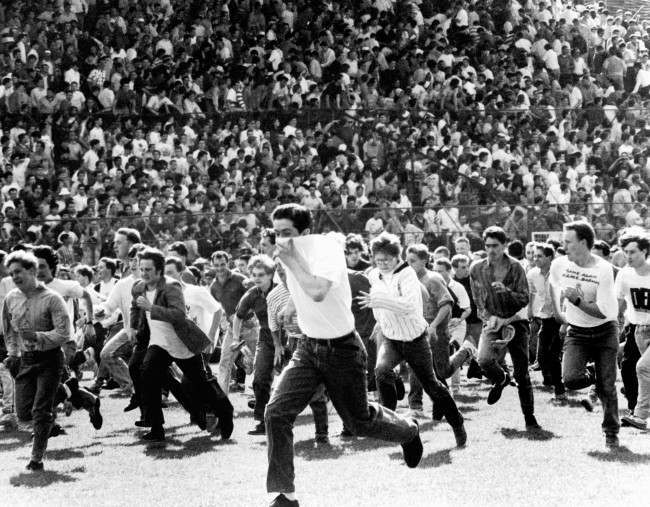
Chaos spills across the pitch as a large group of football supporters surges forward, bodies leaning into the sprint and faces set with urgency. In the foreground, men in rolled sleeves, denim, and trainers run shoulder to shoulder, some glancing sideways as if reacting to movement just out of frame. Behind them, a packed stand rises in dense layers, a stark reminder of how closely the crowd and the action could collide in an era before modern segregation and all-seater stadiums.
The title points to Chelsea fans “on the rampage” in the 1980s, and the scene fits the decade’s troubled reputation in English football: mass movement, frayed tempers, and a thin line between support and disorder. Clothing and hairstyles ground the moment in its time, while the open space of the playing surface—normally sacred territory—becomes a corridor for running feet. The contrast between the orderly geometry of the terraces and the frantic scatter on the grass heightens the sense of a situation slipping beyond control.
For readers exploring football hooliganism, crowd trouble, and supporter culture, this photograph offers an unvarnished window into matchday volatility during the 1980s. It’s as much about atmosphere as it is about incident: the crush of spectators, the sudden rush, and the vulnerability of stadium environments that had not yet been reshaped by later reforms. Viewed today, it prompts questions about how fandom is policed, how safety is designed, and how a club’s following can be portrayed in the public imagination.