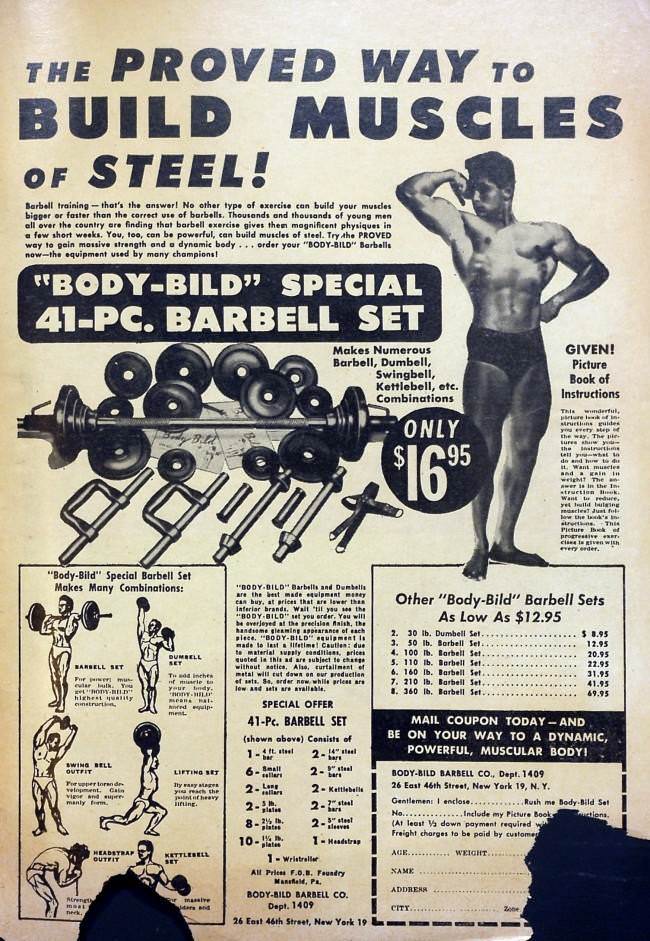
A bold promise blares across the page—“the proved way to build muscles of steel”—and suddenly the title, “No-one laughs are Brian any more,” lands like a punchline with a little bite. The ad’s swaggering copy sells transformation as certainty, the kind of mail-order confidence that doesn’t just offer fitness, but a new social standing: stronger, tougher, and finally taken seriously. It’s funny, yes, but the humor has an edge, because it leans on that familiar story of the underdog who stops being the joke.
On the right, a posed bodybuilder stands like living evidence, while the rest of the layout crowds in with product shots—bars, plates, and attachments arranged as if a small arsenal has been unpacked onto the floor. The typography is loud, the pricing is front and center, and the “special” set is framed as a can’t-miss deal, complete with a coupon promising a “dynamic, powerful, muscular body.” Even without a precise date printed in the post, the design language and sales pitch evoke the golden age of mass-market bodybuilding, when strength culture was packaged for home delivery.
What makes this historical photo worth lingering over is how clearly it captures the marketing of masculinity in a single sheet of paper. The joke in the title becomes a window into older anxieties—about respect, ridicule, and the hope that a new physique could rewrite a person’s story. For readers hunting vintage bodybuilding advertisements, mail-order fitness ephemera, or classic strength-training memorabilia, this is a vivid snapshot of how “getting strong” was sold as a cure for more than just weak muscles.