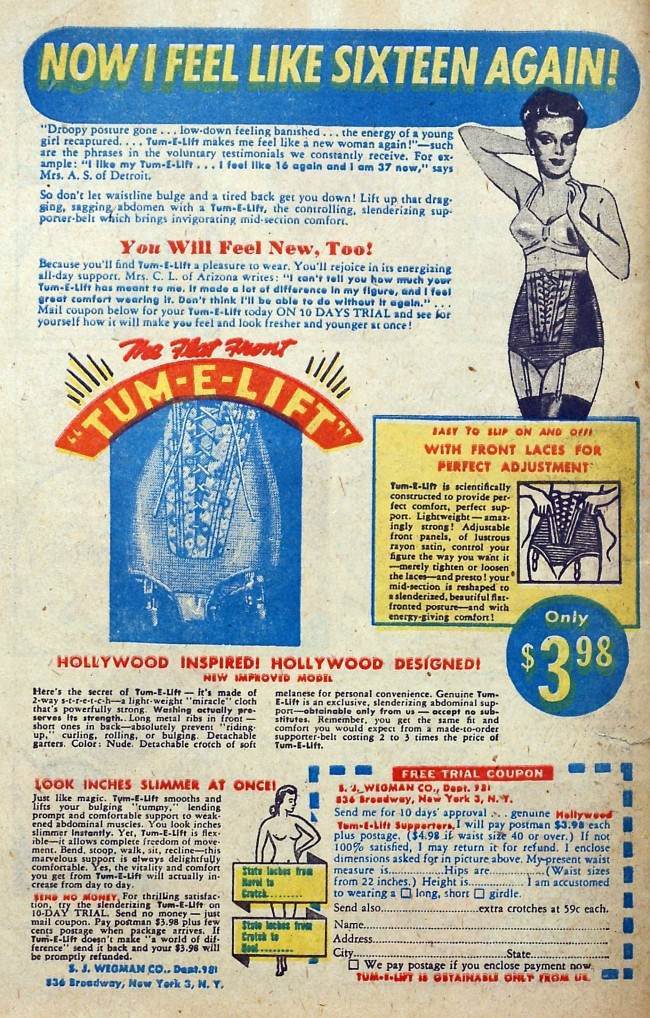
Bold promises leap off the page in this cheeky mid-century advertisement for the “Tum‑E‑Lift,” a body-shaping foundation garment marketed as the fast track to looking “like sixteen again.” The copy leans hard into the era’s obsession with posture, youth, and a tightly controlled silhouette, selling not just a product but a mood: renewed energy, a “new woman” feeling, and an instant upgrade in confidence. It’s the kind of breathless language that makes you hear the pitchman’s patter, even on paper.
At the center of the design is a stylized figure in the garment, rendered to emphasize a cinched waist and lifted torso, while surrounding text suggests a scientific fix for “droopy posture” and the “dragging” of the abdomen. Practical details—front laces, adjustable panels, “easy to slip on,” and an irresistible price tag—frame the Tum‑E‑Lift as both modern and accessible, a consumer miracle for everyday women. The marketing borrows glamour too, invoking Hollywood inspiration as if a little screen-star magic could be tightened on with a few pulls of the laces.
Under the humor of the title—“The Mum‑E‑Lift would ensure that you never breathed out again. Hollywood stars didn’t, so why should you?”—sits a revealing snapshot of beauty standards and the commerce built around them. This historical ad is a sharp reminder of how weight, aging, and femininity were packaged as problems to be solved, often with products that asked bodies to hold themselves unnaturally still. For readers interested in vintage advertising, shapewear history, and the cultural language of “slimming” and “youth,” it’s a wonderfully telling artifact—equal parts funny, unsettling, and familiar.