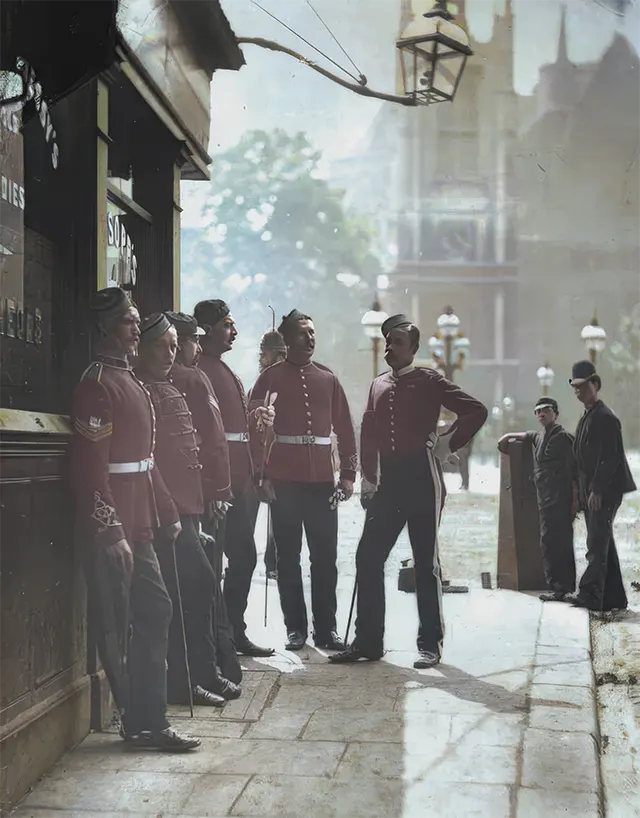
Outside a Westminster public house, a small cluster of British Army soldiers linger at the edge of the pavement, their dark uniforms and pale belts forming a crisp line against the pub’s shadowed frontage. One man leans with practiced ease while others turn toward each other in conversation, canes held lightly as if the pause is brief but familiar. Overhead, a hanging lantern and the tight urban street scene hint at the everyday rhythm of late-Victorian London, where military presence and civilian life constantly brushed shoulders.
Colorization brings out details that often vanish in monochrome: the deep reds of tunics, the muted tones of stone underfoot, and the soft haze of distance that suggests a busy thoroughfare beyond the doorway. The soldiers’ caps, tidy buttons, and upright stances speak to discipline, yet their relaxed grouping feels candid—less parade ground, more street corner. In the background, a few civilians stand apart, watching or waiting, adding a quiet counterpoint to the uniformed figures.
Westminster in the 1890s was both the seat of national power and a neighborhood of pubs, shops, and constant foot traffic, making it a fitting stage for moments like this. The public house serves here not just as a building but as a social waypoint—a place where news, gossip, and small reprieves passed as easily as pints. For readers drawn to British military history, Victorian London street life, or the artistry of photo colorization, this scene offers a grounded glimpse of how ordinary time looked when empire and everyday routine met at the pub door.