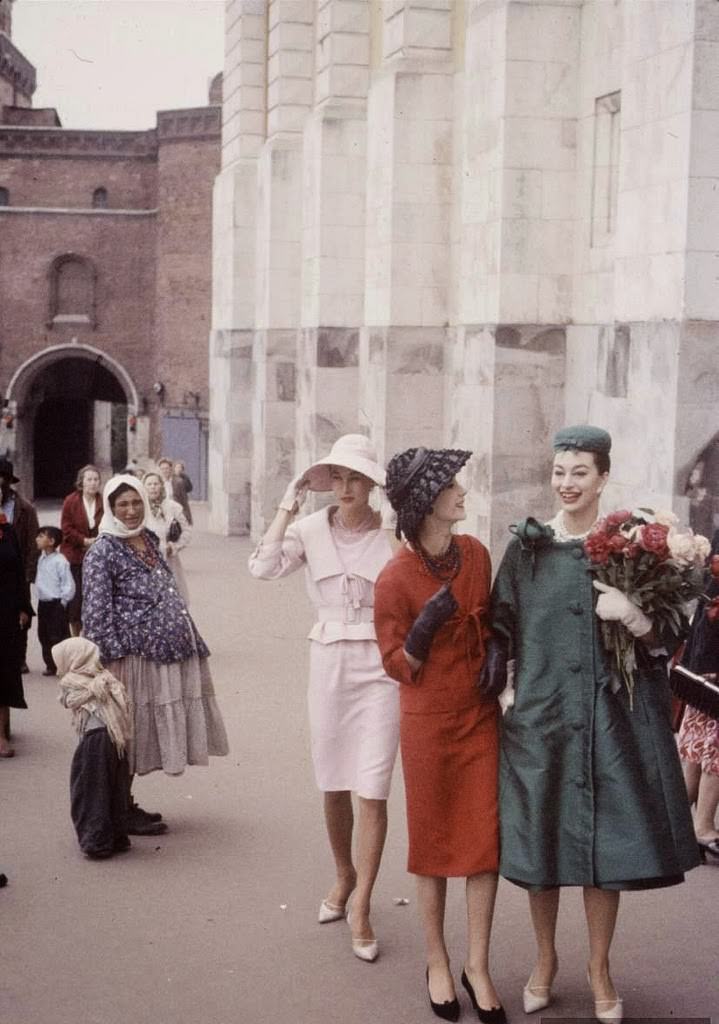
Silk-like coats, slim gloves, and sculpted hats glide past a fortress-like wall as if Paris had briefly rewritten the rules of a Soviet street. In the foreground, three impeccably styled women move with runway confidence—one in a deep green coat cradling a bouquet, another in a vivid red dress, and a third in pale pink beneath a wide-brimmed hat—turning everyday pavement into a fashion moment that feels daring, even theatrical.
Behind them, onlookers in headscarves and practical layers pause, watch, and measure the spectacle against the rhythms of ordinary life. The contrast is the story: couture elegance set against austere architecture and a crowd dressed for work and weather, creating a visual collision between Western high fashion and Soviet public space. Faces and posture suggest curiosity more than hostility, as if the city is testing a new silhouette in real time.
Tied to the title’s “1959 fashion shock,” the photograph reads like a snapshot of cultural diplomacy where clothing becomes a language of influence. Dior in Moscow—whether through a formal presentation, a visit, or a media moment—signals the thaw-era fascination with modernity, luxury, and the promise of cosmopolitan style. For anyone searching fashion history, Cold War culture, or Soviet street life, this scene offers a rare, color-soaked glimpse of how quickly a well-cut coat could turn heads and start conversations.