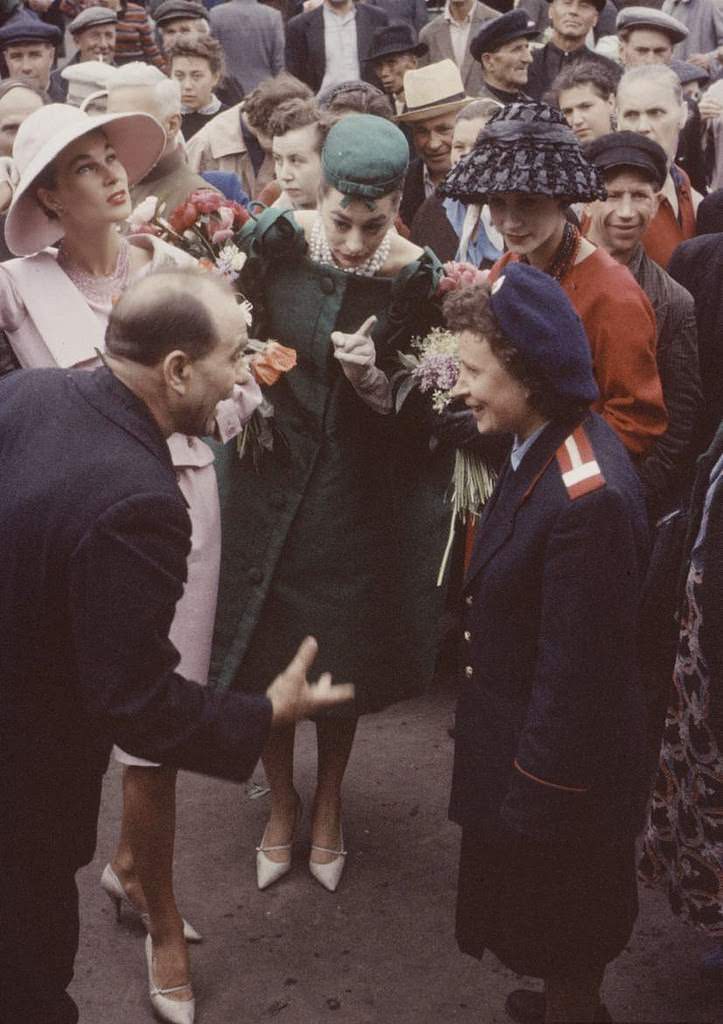
Silk hats and tailored coats cut a striking line through a sea of work caps and plain jackets, turning an ordinary street crowd into a living stage for Cold War curiosity. In the foreground, elegantly dressed women clutch bouquets while onlookers press in close, their faces registering everything from delight to skepticism. The contrast is the story: Paris-style polish meeting Soviet everyday life at arm’s length, with fashion acting as the boldest kind of translation.
Crowds matter in fashion history because they reveal what words can’t—how style lands when it arrives unannounced in public space. Here, the couture silhouettes, gloves, pearls, and sharp heels read like a moving advertisement, while the surrounding spectators provide the real commentary through their attention and body language. Even without a runway, the street becomes a catwalk, and the idea of “Dior in Moscow” feels less like a slogan than a small cultural shockwave.
For readers searching the crossroads of fashion and culture, this photo evokes the 1959 moment when Western haute couture briefly stepped into the Soviet orbit and made everyone look twice. It’s a reminder that clothing can be diplomacy, spectacle, and provocation all at once—especially when the audience is not a ticketed crowd but the city itself. The result is an unforgettable snapshot of style as soft power, where a bouquet, a brimmed hat, and a curious gaze carry the weight of an era.