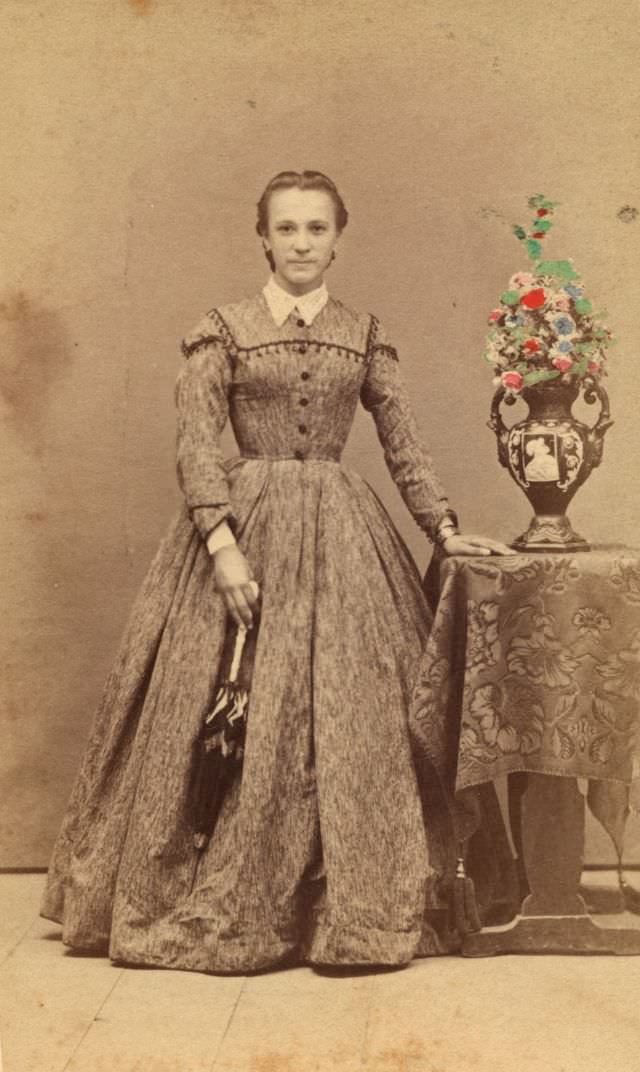
Poised beside a small table, a young Victorian girl stands in a studio setting with the calm, practiced stillness early photography demanded. Her hair is neatly parted and smoothed back, and her expression is restrained rather than playful, reflecting the era’s expectations of propriety in portraiture. A patterned table covering and an ornate urn filled with hand-tinted blossoms add a soft domestic note, balancing the formality of the pose.
The dress is the real lesson in 1860s girls’ fashion: a fitted bodice with a crisp white collar, long sleeves, and decorative trim that emphasizes the shoulder line. Below the waist, the skirt spreads into a wide bell shape typical of mid-Victorian silhouettes, suggesting the structured underpinnings—such as petticoats or a cage crinoline—that helped create that volume. Even in a youthful wardrobe, the details communicate careful construction and respectability, with buttons, seams, and texture meant to be read by the camera.
Small accessories round out the story of fashion and culture in the 1860s, when clothing signaled class, upbringing, and readiness to appear in public. The girl holds a dark item—likely a shawl or wrap—while her other hand rests on the tabletop, a common pose that anchors the figure and shows off sleeve and cuff. Together, the formal studio backdrop, the floral prop, and the precisely arranged garments offer a vivid glimpse into Victorian childhood dressed in miniature versions of adult style.