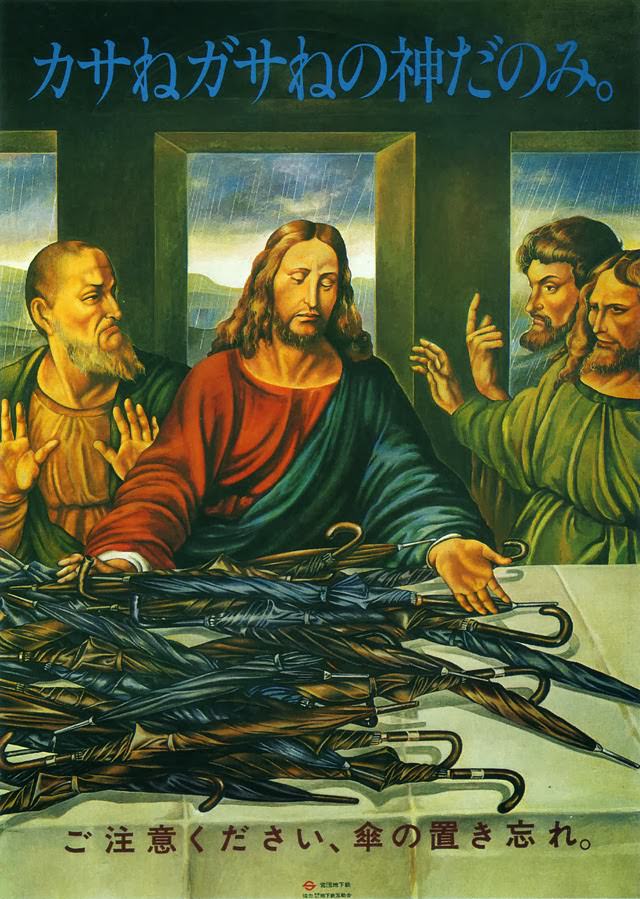
Rain runs down the windowpanes behind a solemn, familiar sacred scene, while the foreground is crowded with a tangle of closed umbrellas laid across a white surface. The contrast is playful and slightly unsettling: halos and gestures of blessing share space with everyday commuter clutter, turning a simple “lost and found” moment into something closer to a parable. Japanese text at the top reinforces the devotional tone, yet the message feels pointedly modern, like a sermon delivered in the language of public manners.
At the bottom, the poster’s warning reads as a practical reminder not to leave your umbrella behind, but the composition invites more than simple compliance. The heavy pile of handles and hooked canes suggests repetition—many people, the same mistake—while the rain outside hints at why umbrellas become so easy to forget once the weather clears. In October 1981, this kind of public-safety or courtesy artwork shows how everyday life could be nudged by design that borrowed authority from religious iconography.
Posted under “Artworks,” this historical image works beautifully for readers interested in Japanese graphic design, vintage public notices, and the way humor can sharpen a civic message. The warm, painterly shading and theatrical staging give it an almost museum-like presence, even as it speaks to a mundane habit most of us recognize. “Don’t forget your umbrella” becomes less a scold than a story—about rain, routine, and the small rituals of looking after what we carry.