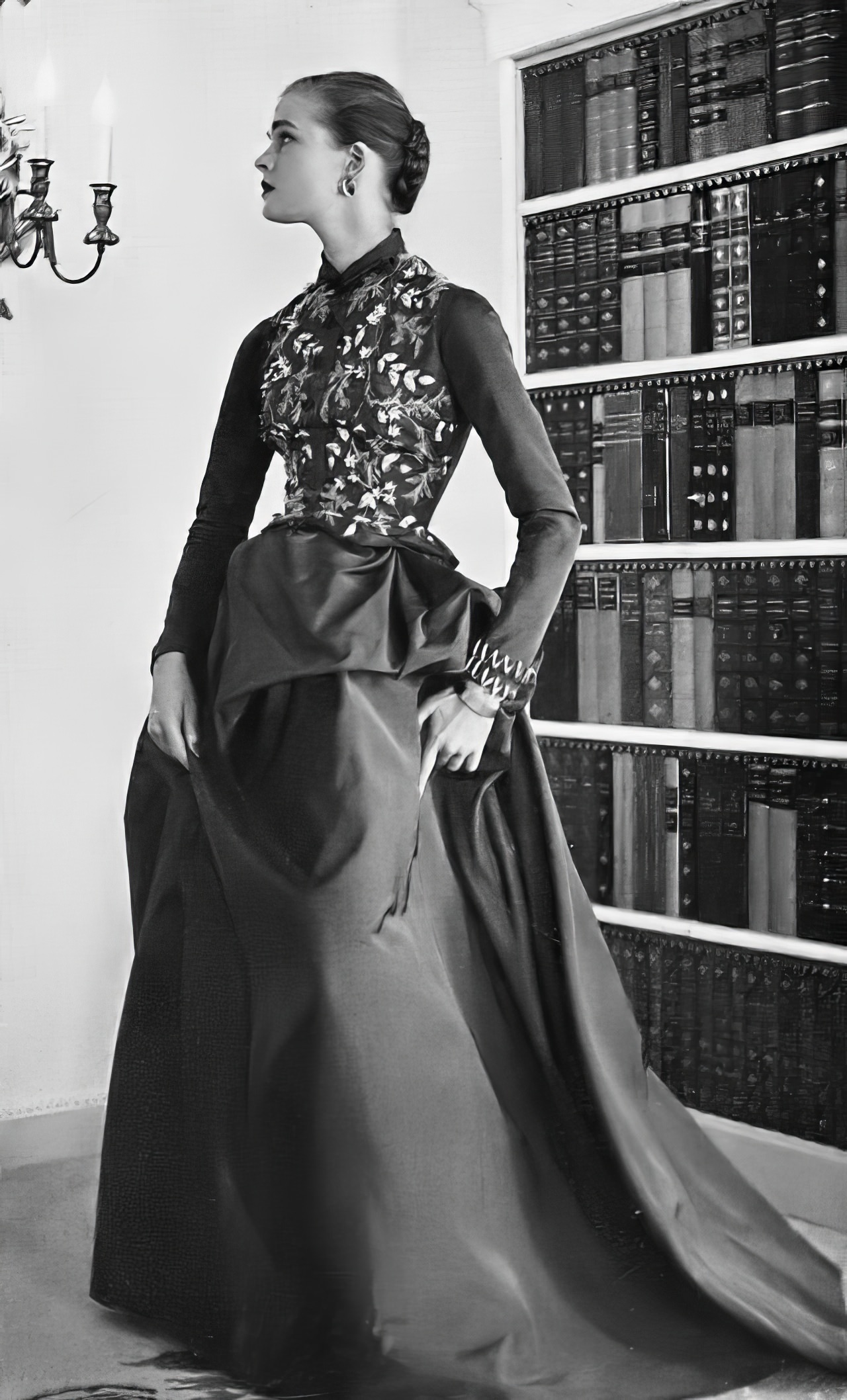
Poised in profile, Susan Abraham stands with the composed assurance that defined 1950s fashion modeling, her gaze turned toward an unseen point beyond the frame. The mole-brown faille gown—structured yet fluid—falls in a generous sweep, its crisp fabric catching the light in broad, sculptural planes. A fitted, long-sleeved bodice with floral detailing adds texture and contrast, while the cinched waist emphasizes the era’s celebrated silhouette.
Behind her, a wall of bookcases filled with leather-bound volumes sets a quietly aristocratic mood, as if couture has stepped into a private library rather than a runway. The restrained interior—plain wall, simple floor, and a classic wall sconce—keeps attention on the gown’s architecture: the draped overskirt, the controlled volume, and the subtle train that trails to the right. Accessories are minimal but telling: hoop earrings, a bracelet, and a neat updo that frames the neckline and strengthens the portrait’s elegant line.
Fashion photography of this period often balanced glamour with a sense of cultured domesticity, and this scene plays that tradition beautifully. The image reads as both style document and character study, capturing how mid-century couture relied on fabric, posture, and setting to suggest refinement. For readers searching 1953 fashion, Susan Abraham, or the enduring appeal of faille evening gowns, this photograph offers a rich glimpse into the aesthetics of postwar elegance and the storytelling power of classic editorial portraiture.