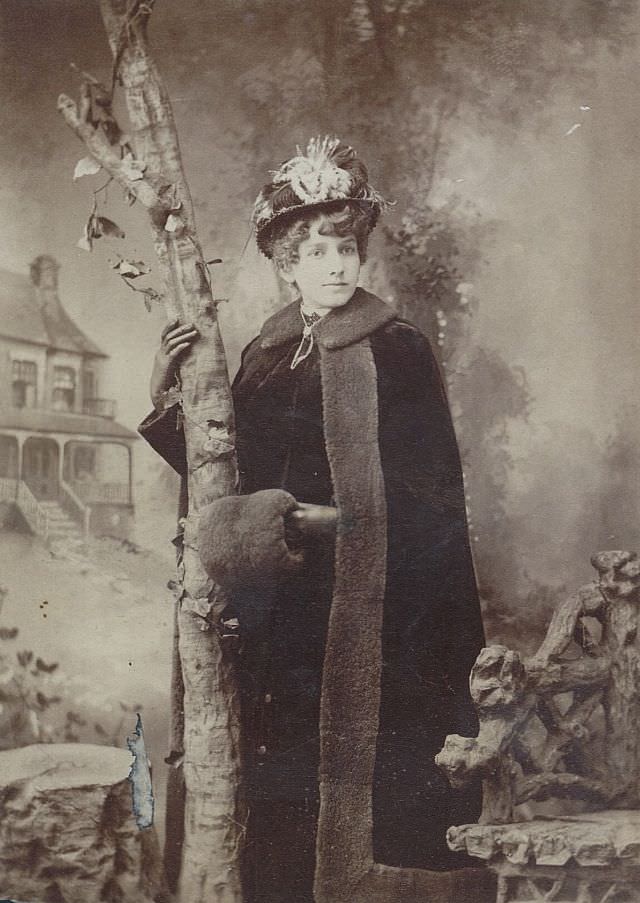
Poised beside a slender birch trunk, a young woman turns her gaze slightly away from the camera, as if caught mid-thought during a winter promenade. Her long, dark coat falls in a clean vertical line, set off by a plush scarf that drapes down the front, while a soft fur muff rests in her hands—practical warmth rendered as a fashionable accessory. Topping the ensemble is a decorated hat with light-colored trim, adding a bright flourish that frames her face and curls.
Behind her, the studio setting hints at the era’s taste for theatrical backdrops: a painted outdoor scene with a house and distant trees blends into misty tonal shading, creating the illusion of depth. A rustic bench or sculpted prop at the right edge and a low foreground element lend texture, suggesting a genteel landscape without requiring the discomfort of real winter weather. The careful composition and controlled lighting reflect the skill of a professional portrait studio, matching the title’s reference to the Sunbeam Gallery in Peoria, Illinois.
As a piece of late-19th-century women’s fashion, the portrait highlights how clothing signaled both season and status, emphasizing rich materials—fur, heavy fabric, and trim—over bold pattern. The muff, scarf, and hat work together as a coordinated statement, balancing utility with the era’s preference for refinement and display. For researchers and vintage-style enthusiasts, this Peoria studio portrait offers a vivid glimpse into 1890s fashion culture in the American Midwest, where winter attire could be as expressive as it was protective.