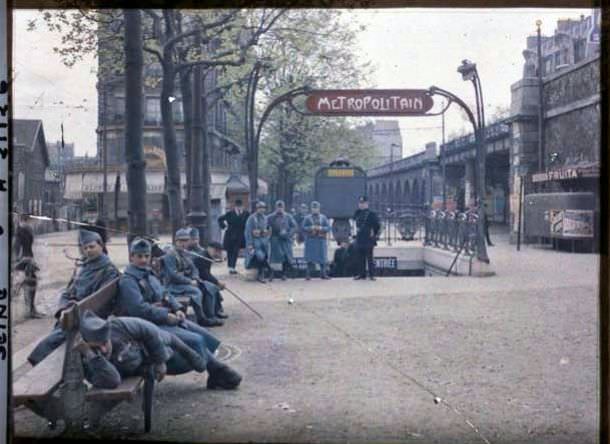
Under the curving “Métropolitain” sign, a Paris street corner in the 16th arrondissement becomes a small stage where the city’s new underground meets the older rhythms of boulevard life. The entrance railing and stairwell draw the eye inward, while a line of trees frames the pavement and softens the hard geometry of nearby façades. Even with the hush of a still image, the scene suggests movement—commuters threading past the gate, conversations drifting along the sidewalk, and the steady pulse of an expanding capital.
On the left, benches are occupied by figures in uniform, lounging and leaning with a familiarity that hints at routine pauses rather than a formal pose. Their presence anchors the foreground and gives scale to the broad open space, where pedestrians gather near the metro access as if waiting, watching, or simply passing time. Behind them, street details—fencing, signage, and the long stretch of buildings—create a layered perspective that rewards a slow look.
Colorization lends the photograph an immediacy that feels surprisingly modern, yet it also emphasizes how different everyday Paris once looked in dress, street furniture, and public transport design. Credited to Frédéric Gadmer, the image works both as documentary evidence and as atmosphere: a slice of urban life in Paris (XVI arr.) that speaks to transit history, neighborhood character, and the texture of ordinary afternoons. For anyone searching for early Métro scenes, Paris street photography, or glimpses of the 16th arrondissement’s past, it offers a vivid point of entry.