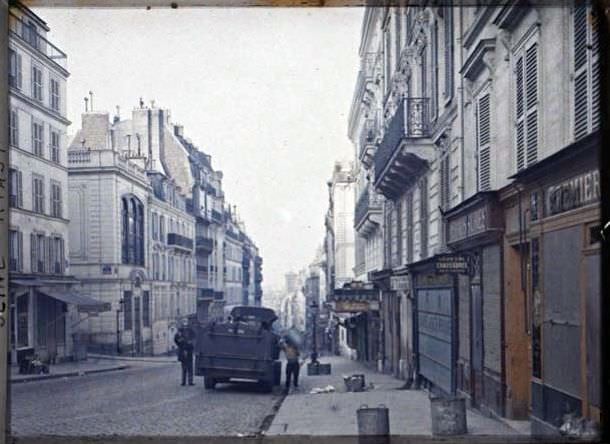
Along Rue des Martyrs, the city falls away toward Notre-Dame-de-Lorette, framed by tall Parisian façades and a widening perspective that draws the eye down the street. The intersection with Rue de la Tour d’Auvergne opens on the left, while a heavy vehicle sits in the roadway and a few figures linger nearby, small against the dense masonry. In this colorization of Stéphane Passet’s work, pale stone, muted shutters, and shopfront signage help the familiar rhythm of Paris architecture feel immediate rather than distant.
Details along the right-hand side suggest an everyday commercial corridor: painted storefronts, glass panes, and lettering that would have guided pedestrians from one business to the next. The street surface appears uneven and lightly worn, with scattered objects at the curb hinting at deliveries, refuse, or street works—ordinary clutter that anchors the scene in lived experience. Even without a precise date on the image, the combination of building style and street activity evokes an earlier chapter of Montmartre’s lower slopes and the Notre-Dame-de-Lorette quarter.
Passet’s viewpoint emphasizes how Paris streets functioned as both thoroughfares and stages, where commerce, traffic, and neighborhood life overlapped in a single frame. For readers interested in historic Paris photography, Rue des Martyrs offers a compelling case study of urban continuity—many corners change in detail while retaining their essential geometry. As a WordPress post feature, this image pairs beautifully with discussions of Parisian streetscapes, early color processes and modern colorization, and the evolving identity of the 9th arrondissement’s most storied routes.