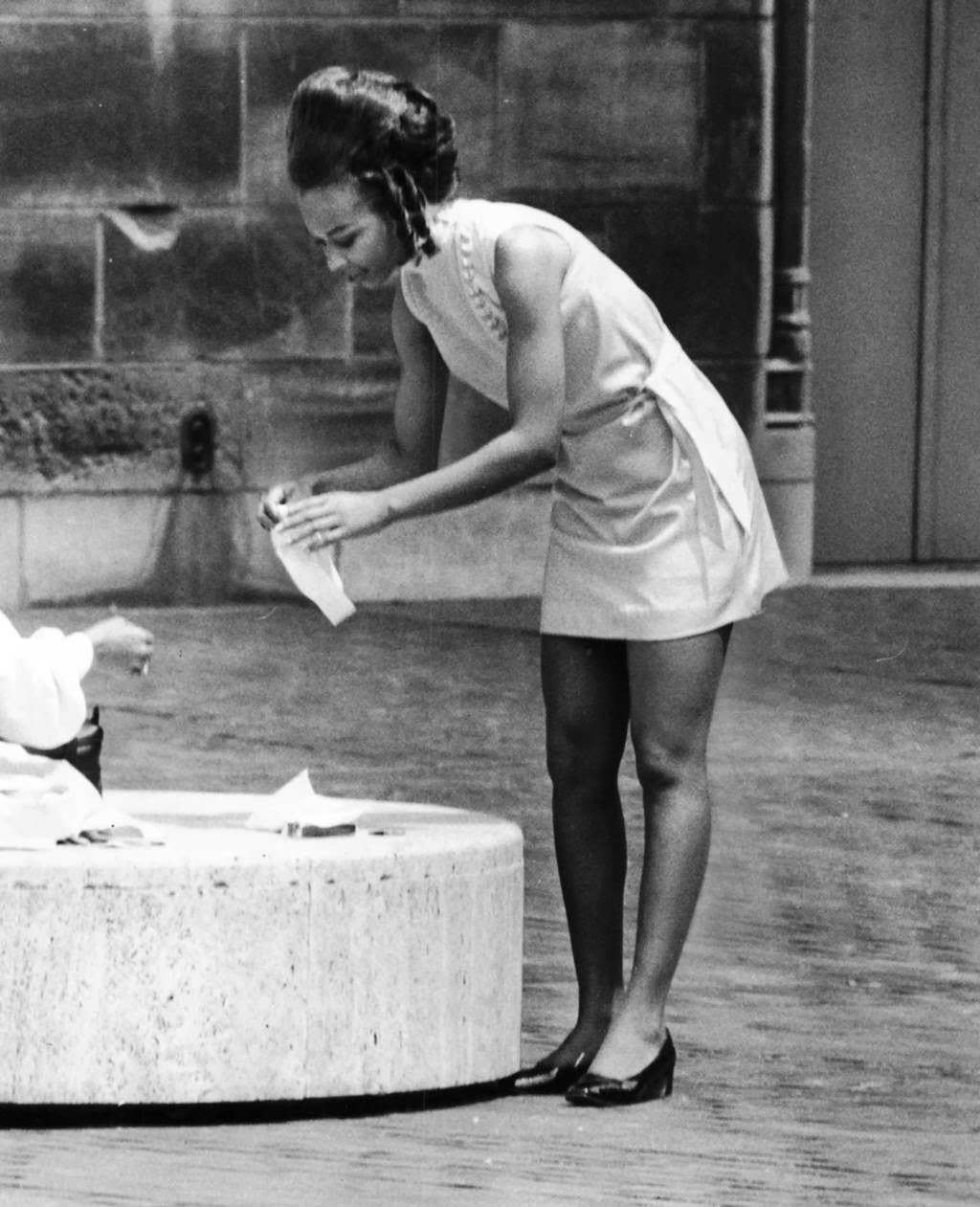
Leaning over a round stone bench, a young woman concentrates on unwrapping her lunch, her sleeveless top and sharply cut mini skirt forming a clean, modern silhouette against the plain façade behind her. The hem sits well above the knee, and the outfit’s simple lines—paired with dark low heels—signal the confident, pared-down style that made the miniskirt such a lightning rod in everyday street fashion. Even in this casual moment, the pose and framing turn ordinary lunchtime routine into a small tableau about changing taste and public attention.
Across the edge of the frame, male onlookers register as partial figures—hands, sleeves, and bodies just off-center—echoing the title’s wry suggestion that the scene is as much about the gaze as it is about clothing. That tension is part of the miniskirt’s history: a garment celebrated as youthful freedom and modern chic, yet often treated as public spectacle. The photo freezes that complicated social theater, where a simple act like opening a paper-wrapped meal becomes a performance in a shared urban space.
For readers interested in 1960s fashion and culture, this image works as a compact lesson in how trends moved from runways and magazines into sidewalks, benches, and lunch breaks. The miniskirt here is not a costume but a lived-in choice—practical, stylish, and unmistakably symbolic—inviting reflection on shifting norms around women’s appearance and autonomy. As credited to Jack Mulcahy and the Chicago Tribune (Jan. 30, 2014), the post pairs visual storytelling with the broader history of how “beyond the knee” became a defining line in modern style.