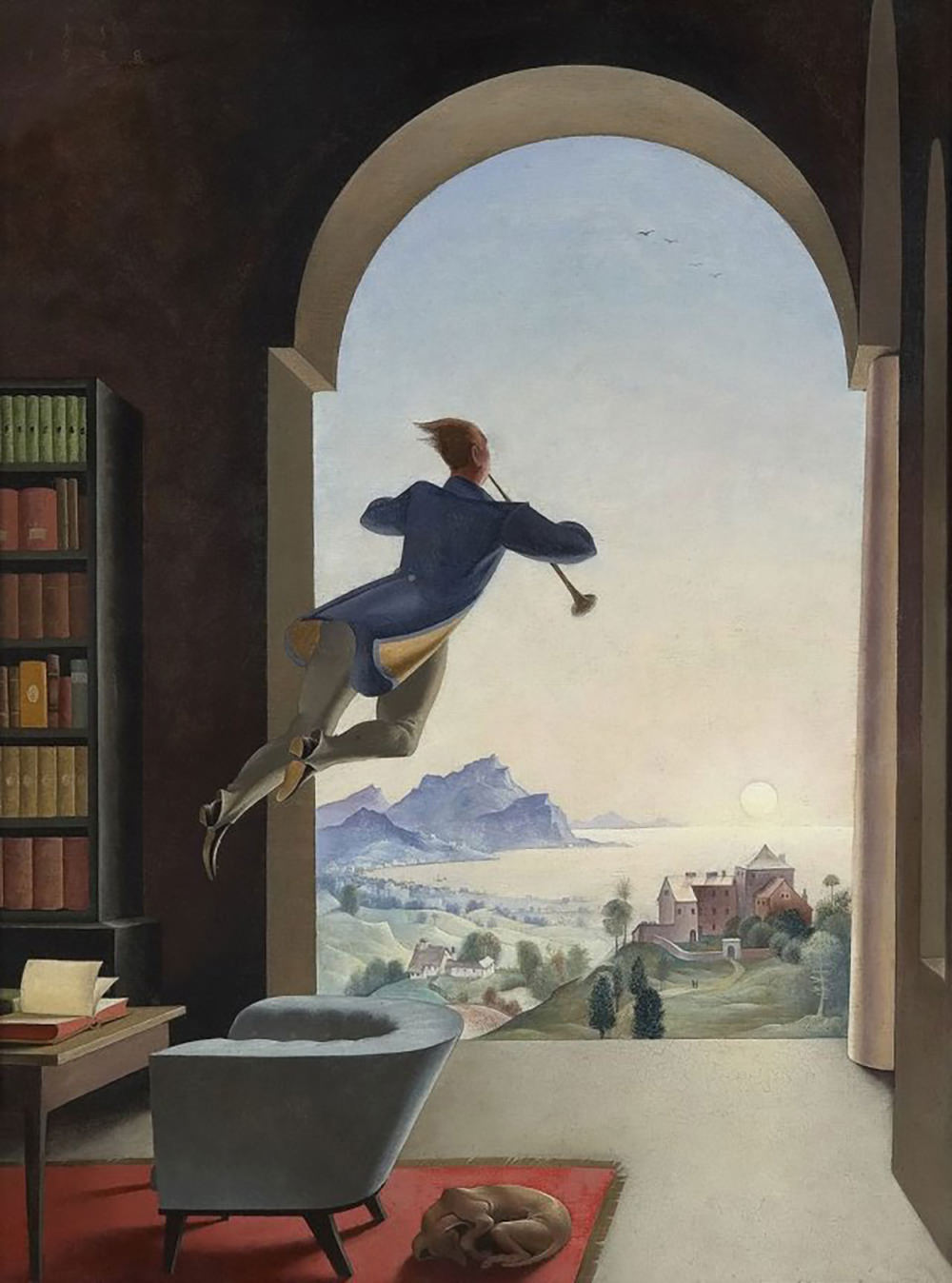
Under a vast arched opening, Franz Sedlacek’s *Evening Song* (1938) stages a moment that feels half domestic, half dream. A figure in a blue coat leans outward as if caught mid-flight, raising a slender horn toward the pale sky, while the quiet interior—bookshelf, chair, and a small sleeping dog on a red rug—anchors the scene in everyday life. The contrast between the shadowed room and the luminous outdoors draws the eye past the threshold, inviting readers to linger on the painting’s uncanny calm.
Beyond the window-like arch, a serene landscape unfolds: soft hills, a cluster of buildings resembling a manor or small castle, and distant mountains fading into evening light. A low sun hangs near the horizon, its glow washing the water and sky in muted tones, while a few birds punctuate the open air. Sedlacek’s careful geometry—solid architectural framing against expansive space—turns the view into a stage where sound, silence, and distance seem to coexist.
Painted on the eve of wartime Europe, the work carries an atmosphere of suspended time that rewards close looking. The “song” suggested by the title feels less like performance than signal: a solitary call cast outward from a private room into a world that appears tranquil yet remote. For anyone searching for Franz Sedlacek 1938, surrealist-leaning Austrian art, or evocative interwar-era paintings, *Evening Song* offers a memorable meditation on escape, longing, and the fragile boundary between shelter and horizon.