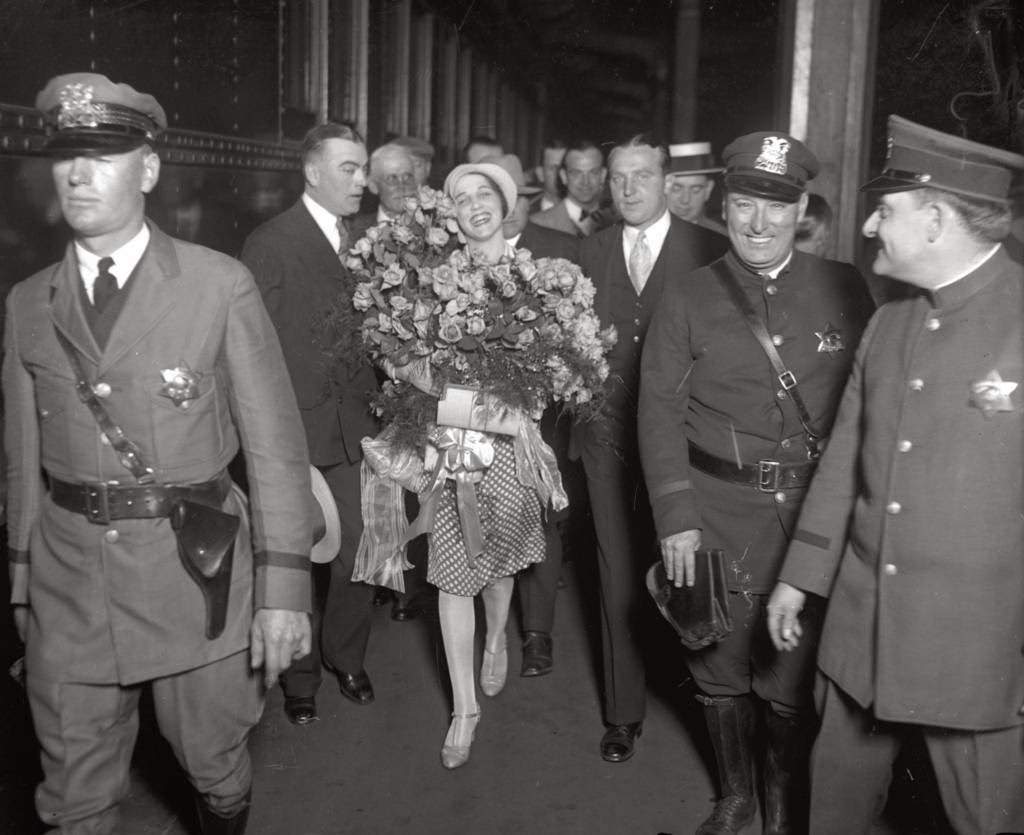
Chicago’s 1920s swagger comes through in a single, bustling moment: Ella Van Hueson stepping forward with an armful of roses, smiling as she’s shepherded through a dense crowd of suited men and uniformed officers. The scene feels like a homecoming staged for the cameras—part civic ceremony, part celebrity crush—where public order and public adoration mingle shoulder to shoulder. Even without a float or confetti in view, the parade spirit is unmistakable in the way she’s framed by admirers and officials alike.
Her cloche-style hat, patterned dress, and confident stride echo the flapper-era shift in fashion and attitude, when modern femininity was marketed as both style and spectacle. Winning the International Pageant of Pulchritude in Galveston, Texas, then returning as “Miss Universe,” placed a young woman at the center of a new kind of media ritual—one built on headlines, photo ops, and the promise that glamour could travel as fast as the train back home. The bouquet is almost comically oversized, a visual shorthand for victory that also hints at the commercial pageantry surrounding beauty titles in the Jazz Age.
Look closer and the photograph doubles as a street-level portrait of the era’s civic theater: badges, caps, and official coats marking the boundaries of celebration, while the crowd presses in to witness a local triumph. For readers drawn to Fashion & Culture, this image offers more than a winner’s welcome—it’s a snapshot of how cities like Chicago embraced modern celebrity, turning personal achievement into a communal event. In the end, the real subject may be the moment itself: a roaring decade pausing just long enough to applaud.