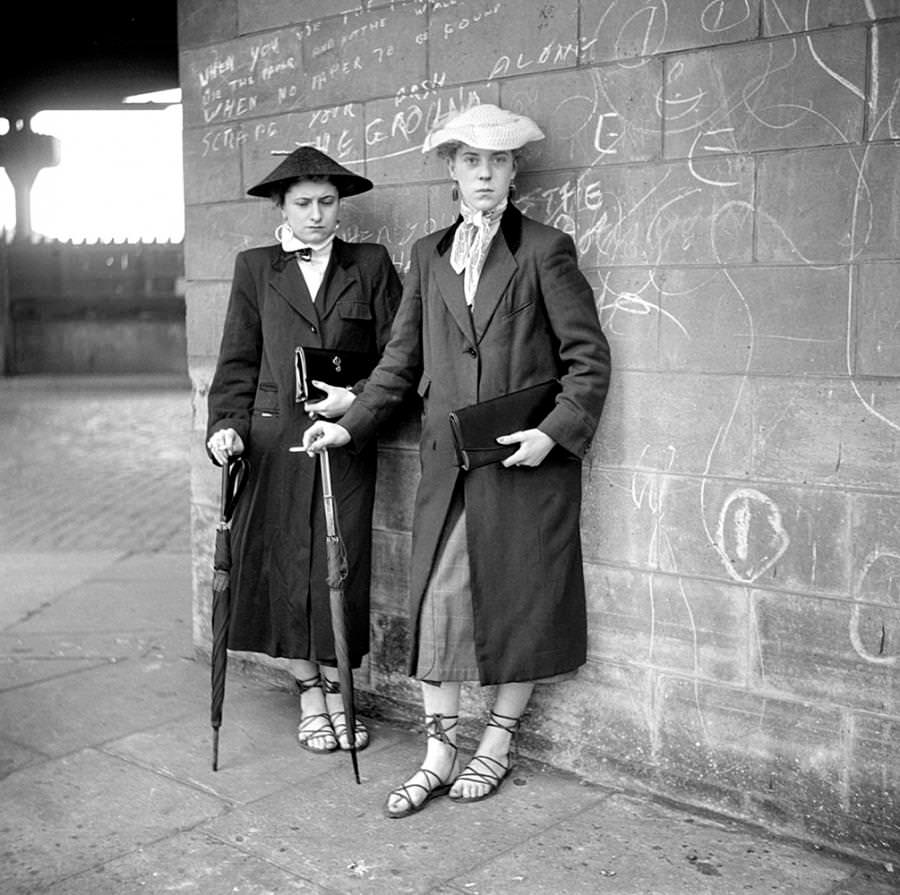
Under a graffiti-scribbled wall, two 17-year-old Teddy Girls—Pat Wiles and Iris Thornton from Plaistow—hold their ground with the cool assurance of London youth culture in January 1955. Ken Russell’s lens catches them in long, tailored coats and sharp hats, their expressions serious rather than playful, as if daring the passerby to look twice. One grips a closed umbrella like a walking stick, while the other tucks a slim clutch under her arm, turning everyday accessories into deliberate style statements.
What draws the eye, though, is the footwear: lace-up espadrilles wound around the ankles, a striking detail against the heavy drape of their coats. The crisscrossing ties and open toes add a flash of summer nonchalance to an otherwise строг, Edwardian-inspired silhouette—an unmistakable hallmark of Teddy Girl fashion. The combination of borrowed menswear lines, careful grooming, and bold shoe choice reads as both homage and provocation, a working-class remix of “posh” style worn on their own terms.
The setting—an urban passageway with scuffed pavement and chalked messages—anchors the image in the everyday postwar city, where fashion became a form of presence and defiance. Rather than a staged studio portrait, the photograph feels like street history: youth style documented where it was lived, argued over, and admired. For anyone searching the roots of British subcultures, 1950s street fashion, or the story of Teddy Boys and Teddy Girls, this Russell photograph offers a vivid, grounded glimpse of how identity could be stitched, laced, and worn.