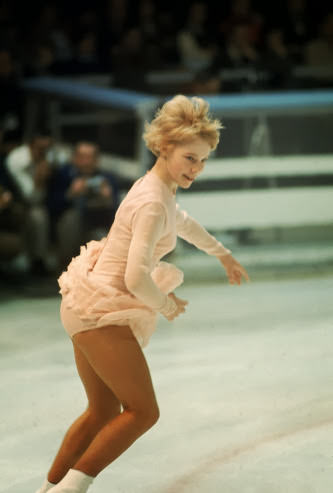
A burst of motion sweeps across the Olympic ice as American figure skater Janet Lynn leans into her edge, her pale costume fluttering with the turn. The scene, set at the Grenoble Olympics of 1968, balances grace and athletic intensity—arms poised, knees flexed, and focus fixed on the next beat of choreography. In the soft blur of the arena behind her, spectators and officials fade into a backdrop that makes the performance feel even more immediate.
Color adds warmth to a sport often remembered through monochrome broadcasts, highlighting the textures of rink, dress, and lighting in a way that places the viewer rinkside. Lynn’s youthful presence and confident posture suggest the speed and precision required at the highest level of Olympic figure skating, where every jump, spin, and footwork sequence must read cleanly from the farthest seat. The photograph preserves that fleeting instant when technique becomes artistry, and a program’s energy is felt as much as it is seen.
For fans of Winter Olympics history, this Grenoble 1968 moment offers a vivid entry point into an era of changing styles and rising international attention for women’s skating. It’s an ideal archival image for anyone researching Janet Lynn, American Olympic figure skating, or the look and atmosphere of late-1960s competition arenas. As a WordPress feature, it invites readers to linger over the details—costume design, body line, and crowd presence—while recalling how a single performance can define the memory of a Games.