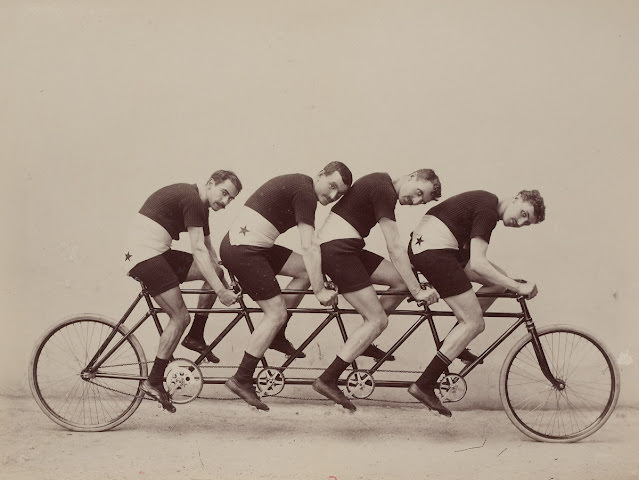
Four riders are lined up in perfect rhythm on an elongated multi-seat tandem, their bodies pitched forward with the focused posture of competitors rather than casual cyclists. Matching dark jerseys and short trousers marked with star emblems give the scene a team identity, while the bare studio-like backdrop keeps attention on the machine’s unusual geometry—repeating cranksets, shared frame sections, and a single front wheel leading the whole effort. The riders glance toward the camera with a mix of confidence and concentration, as if pausing mid-demonstration of speed and coordination.
Jules Beau’s sports photography often favored clarity and form, and here that approach turns tandem cycling into a study of early athletic modernity. The bicycle itself reads like an experiment in efficiency: multiple engines driving one vehicle, demanding timing, trust, and a common cadence. Details such as the narrow tires, upright steering, and simplified components evoke a period when cycling technology and competitive tactics were evolving side by side, and when novelty in sport could look daringly mechanical.
Seen today, the photograph invites questions about how these riders trained, how such tandems handled on track or road, and what spectators made of a team moving as a single unit. For collectors and historians of cycling sport, it’s a vivid example of 19th-century enthusiasm for speed, spectacle, and engineering. Anyone searching for Jules Beau photographs, early bicycle racing imagery, or the origins of tandem cycling will find this image an arresting window into a formative moment in sports culture.