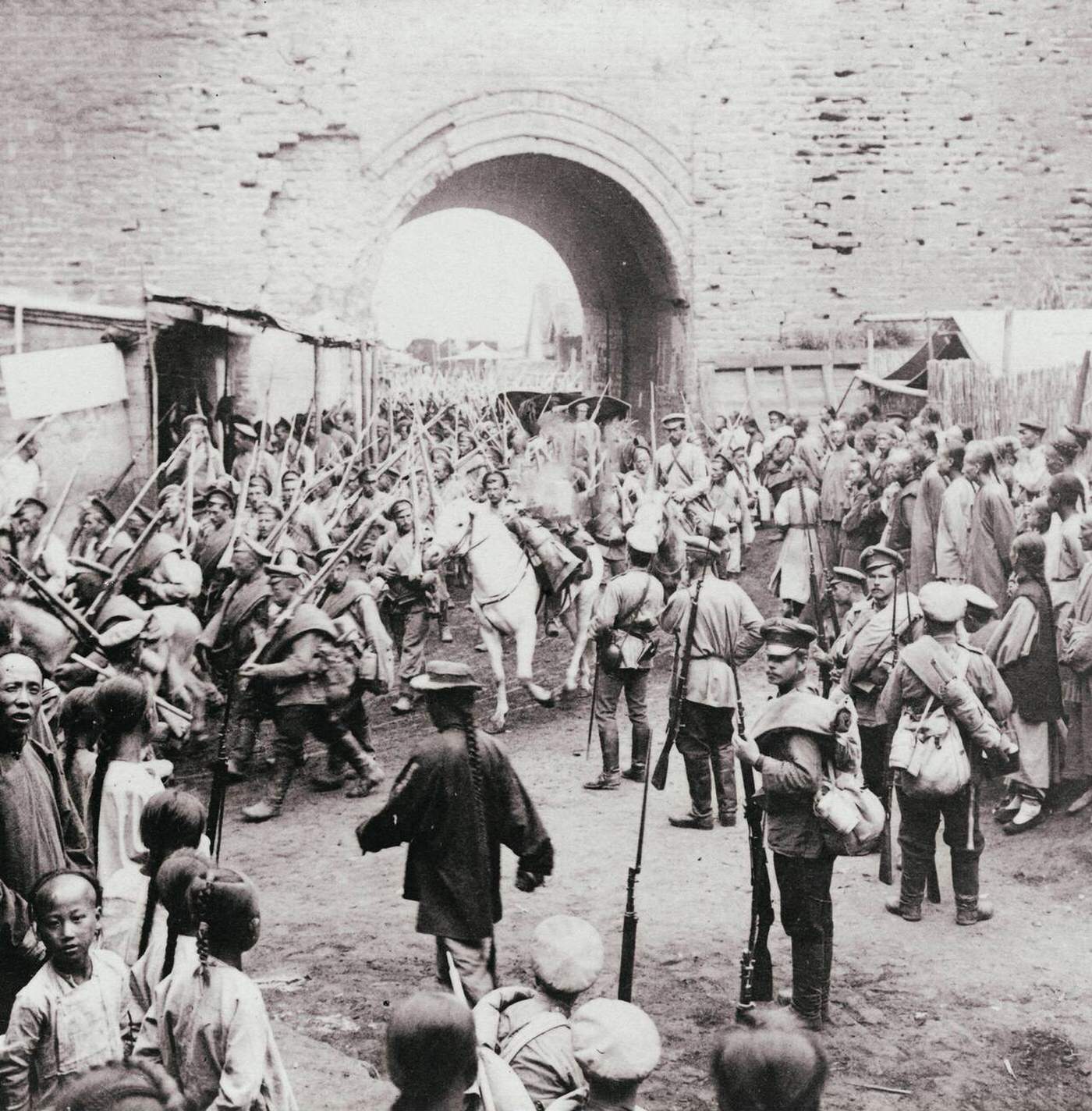
Through the arched gates of Mukden in Manchuria, a column of soldiers from the Russian Empire presses forward, their long rifles raised into a dense thicket of bayonets and barrel lines. The stonework of the passage frames the scene like a stage, while the road beneath is churned into mud by boots, hooves, and the steady movement of men and animals. A mounted figure sits near the center, suggesting command and direction amid the crowding, while packs and rolled bedding hint at the grinding logistics of campaign life in 1905.
Along both sides of the gateway, local onlookers gather close, watching the procession at arm’s length. Faces and clothing differentiate civilians from uniformed troops, and the tight corridor magnifies the sense of scrutiny, as if the city itself is holding its breath. The photo’s compressed perspective turns the entry into a bottleneck of empire—military order pushing through an urban threshold, with everyday life pressed to the margins.
Mukden’s gates were more than masonry; they were symbols of control, access, and vulnerability during a year when Manchuria was a focal point of global attention. Details in the uniforms, the mix of foot soldiers and mounted personnel, and the sheer number of rifles make this an evocative document for readers interested in wars and military history, the Russian Empire, and the Russo-Japanese War era. In a single crowded moment, the image conveys how conquest and occupation were experienced not as abstractions, but as noise, movement, and bodies passing beneath a city arch.