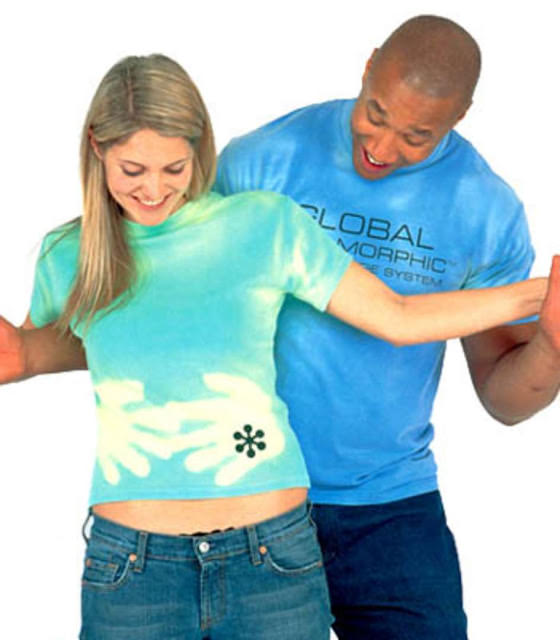
Bright, heat-reactive color blooms across the woman’s T-shirt as she twists and laughs, the fabric shifting from pale green to deeper aqua in irregular patches. A playful handprint-like shape appears over her midsection, echoing the gimmick that made “Hypercolor” shirts feel almost alive. Set against a clean studio-white background, the focus stays on the garment’s changeable surface and the carefree energy that made this trend an instant attention-grabber.
Behind her, a man in a bold blue tee leans in with a grin, as if sharing the joke of a shirt that reveals every warm touch and movement. The composition reads like an advertisement for 1980s and early-1990s youth fashion—casual denim, loud hues, and a sense that clothes could be interactive rather than merely decorative. Even without props or scenery, the body language sells the moment: kinetic, flirtatious, and unselfconsciously fun.
Hypercolor stands as a classic example of how novelty textiles briefly reshaped everyday style, turning a basic T-shirt into a mood ring you could wear. The appeal was simple and visual—watching color morph with heat, sweat, sunlight, or a hand on your side—yet it also exposed the era’s fascination with technology in consumer culture. Today, images like this serve as a compact history of fashion and culture, reminding us how a single fabric innovation could define a generation’s idea of cool.