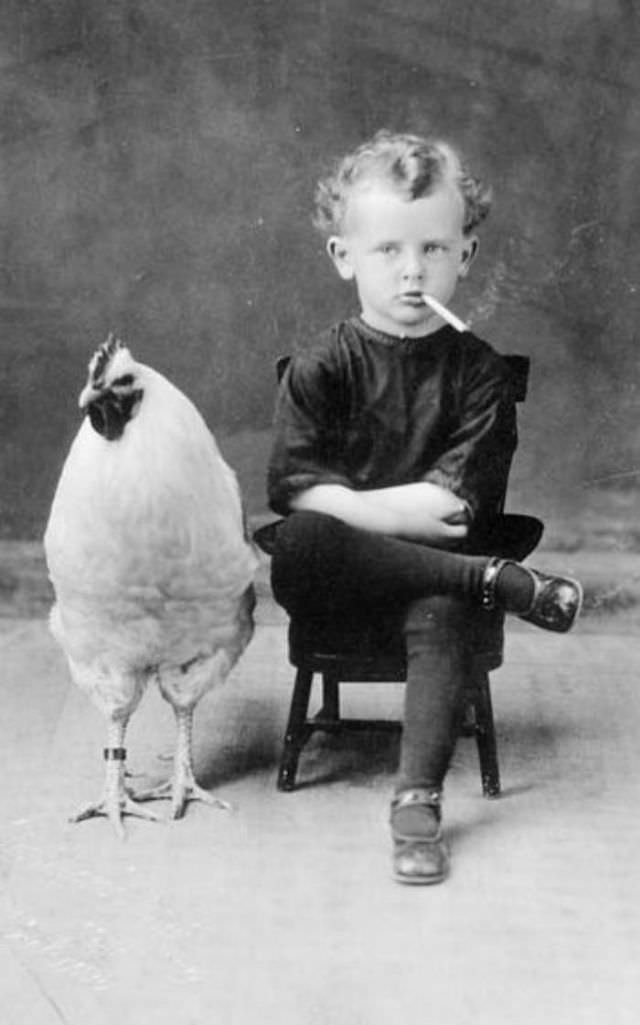
Henri Groulx sits stiffly on a child-sized chair, one leg crossed with the seriousness of an adult, while a cigarette (or prop made to look like one) hangs from the corner of his mouth. His dark outfit blends into the studio setting, making his pale face and steady, almost defiant gaze the focal point. At his side, a large rooster stands as if it belongs in the portrait as much as the boy does, turning a simple pose into something quietly theatrical.
Set in Paris, France around 1920, the photograph plays with contrast—childhood innocence against performative maturity, domestic barnyard life against a formal studio backdrop. The painted background and flat floor create that unmistakable early-20th-century portrait look, where every element is arranged for maximum effect. Yet the humor feels unforced: the rooster’s calm presence and the boy’s stern posture read like a visual joke delivered with a straight face.
For anyone browsing vintage photography, French social history, or quirky antique portraits, this image is a memorable reminder that earlier generations also enjoyed playful staging. The pairing of Henri Groulx and his rooster hints at family pride, rural ties, or simply a spirited sense of mischief carried into the photographer’s studio. It’s the kind of historical photo that invites questions—about childhood, fashion, and attitudes of the era—while still working perfectly as a standalone, funny snapshot from the past.