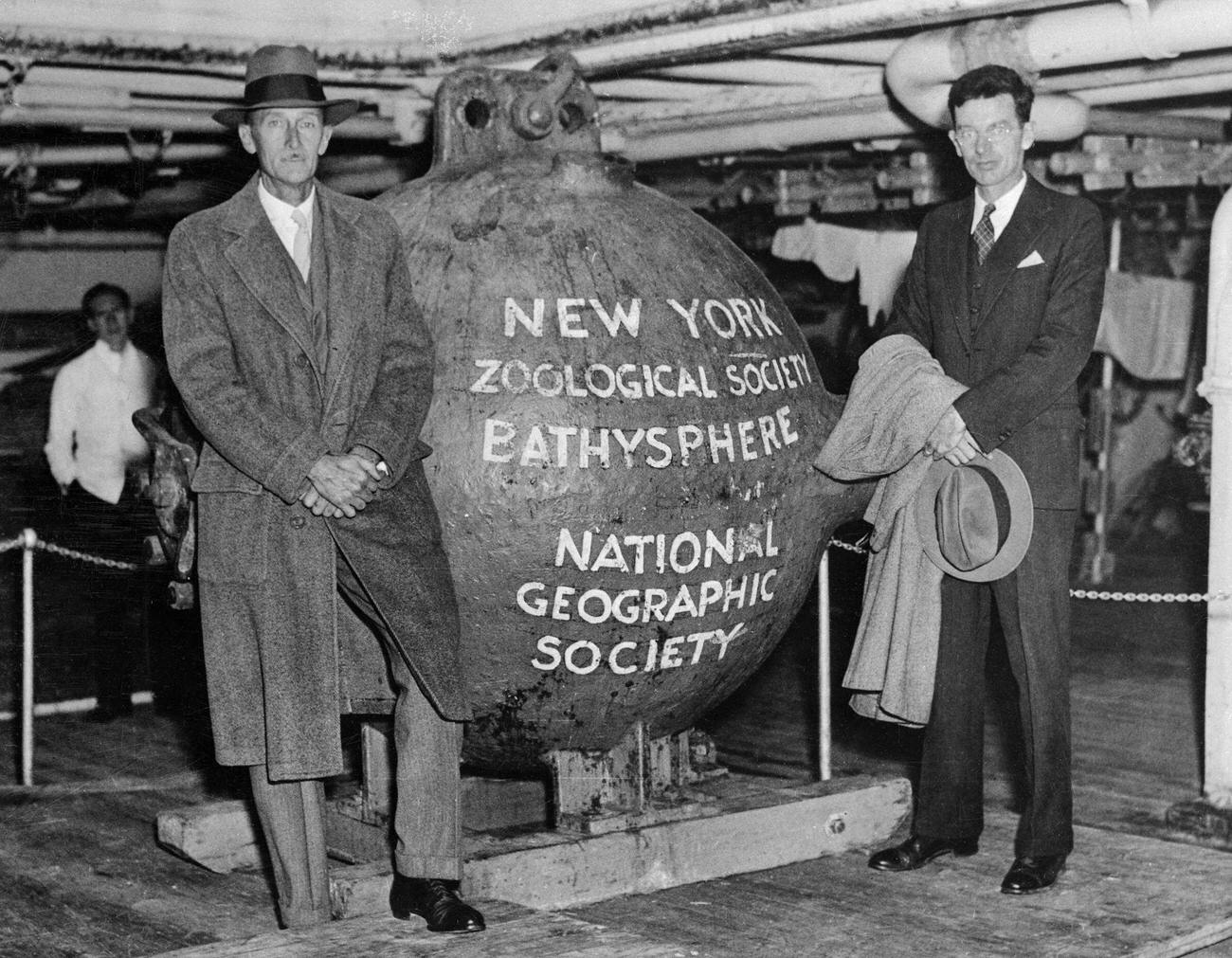
Fresh from a record-setting descent off Bermuda, William Beebe and J. Tee-Van pose beside the blunt, riveted sphere that made such exploration possible. The bathysphere dominates the scene like an industrial planet, its rough surface lettered with the backing of the New York Zoological Society and the National Geographic Society. Dressed in city suits and hats, the two men bridge the worlds of office-bound respectability and deep-sea risk—proof that groundbreaking ocean science often arrived in the same clothing worn on the docks.
Even at rest, the vessel suggests pressure, darkness, and the narrow margin between curiosity and catastrophe. Heavy seams, small fittings, and the sheer mass of the sphere hint at the engineering challenge of sending human observers into the deep when modern submersibles were still decades away. The surrounding shipboard clutter—pipes, shadows, and working space—adds a documentary feel, reminding viewers that “inventions” are rarely sleek at birth; they begin as hard-used tools built to endure.
Returning to New York after their dive, Beebe and Tee-Van became living headlines for early marine exploration, carrying back observations that helped expand the public imagination of the ocean’s depths. For readers interested in the history of technology, exploration, and scientific partnership, this photograph offers a vivid anchor point: the moment a daring experiment re-enters everyday life, hauled aboard and photographed like any other cargo. It’s a compelling snapshot of how institutions, engineering, and human nerve combined to push the frontier of underwater discovery.