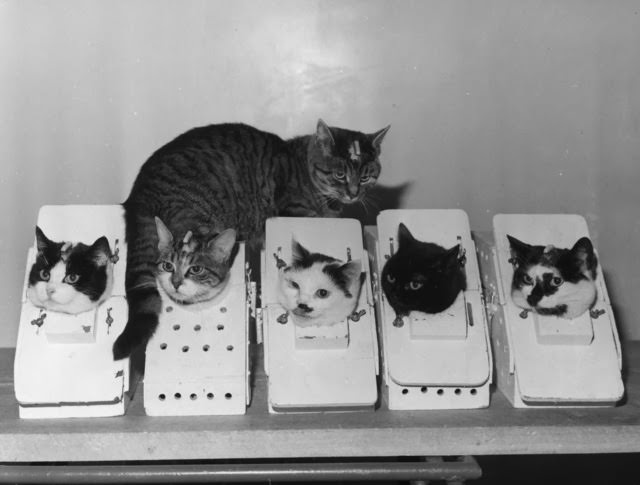
In a stark laboratory setting on Boulevard Victor in Paris, a row of small, hinged boxes sits neatly on a bench, each one framing a cat’s face like an unlikely portrait. Some stare straight ahead with wide, alert eyes; others look off to the side as if listening for the next unfamiliar sound. A larger tabby sprawls across the tops, turning the scene into something that feels half clinical experiment, half surreal comedy.
The title explains the unsettling practicality behind the odd arrangement: these cats were being trained to remain still for long periods, a requirement for rocket flights and the sensitive measurements planned during the early space age. Seen through today’s lens, the photograph reads as a vivid artifact of 1960s space research in France—where improvised apparatus, disciplined routines, and living test subjects intersected in the name of aerospace ambition. Even the clean lines of the boxes and the repetitive layout convey the era’s faith in procedure and control.
There’s also a deeper tension running beneath the humor: the cats’ expressions and confined posture remind us that the space race wasn’t only about rockets and engineers, but also about the bodies—human and animal—placed at the edge of the unknown. As a piece of Paris history and a snapshot of French space program training practices, the image invites reflection on how quickly technological optimism can normalize the extraordinary. It lingers in memory precisely because it is so matter-of-fact, presenting an experiment that feels both absurd and revealing.