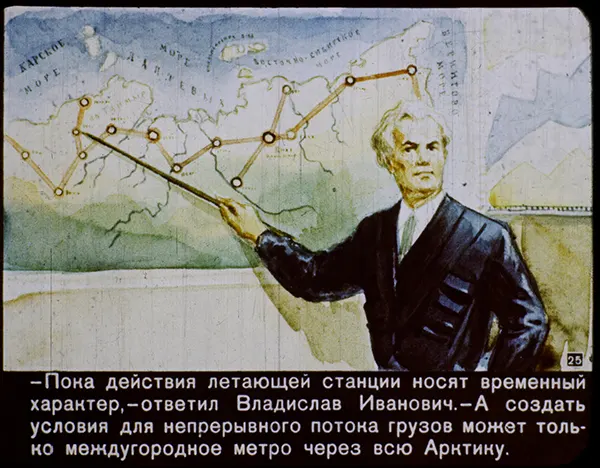
Against a pale map of the far north, a stern, suit-clad figure gestures with a pointer toward a chain of marked stops that snakes across Arctic waters and coastlines. The composition reads like a planning meeting turned propaganda poster: routes are drawn with confident lines, nodes are circled like stations, and the speaker’s posture suggests authority over an immense, sparsely populated space. Russian text anchors the scene in the language of state-scale ambition, turning geography into a promise of connection.
Vladislav Ivanovich’s quoted claim—skeptical of “flying delivery stations” as merely temporary—pushes the viewer toward a grander solution: an intercity metro stretching through the entire Arctic. The idea is startling on its face, yet it fits a familiar historical pattern in Soviet-era visual culture, where technology and transport were framed as instruments to tame distance, weather, and isolation. In this artwork, logistics becomes ideology: uninterrupted delivery of goods is not just commerce, but a triumph of planning over nature.
For WordPress readers interested in Arctic transportation history, Soviet posters, or the visual language of infrastructure dreams, this image offers plenty to unpack. The map, the dotted route, and the pointed directive combine to sell a future of permanent corridors rather than stopgap aerial fixes, echoing broader debates about supply chains in extreme regions. As a historical photo-style artwork, it works beautifully in posts about utopian engineering, Cold War-era mobility, and how ambitious transit concepts were used to imagine the Arctic as a connected, controllable frontier.