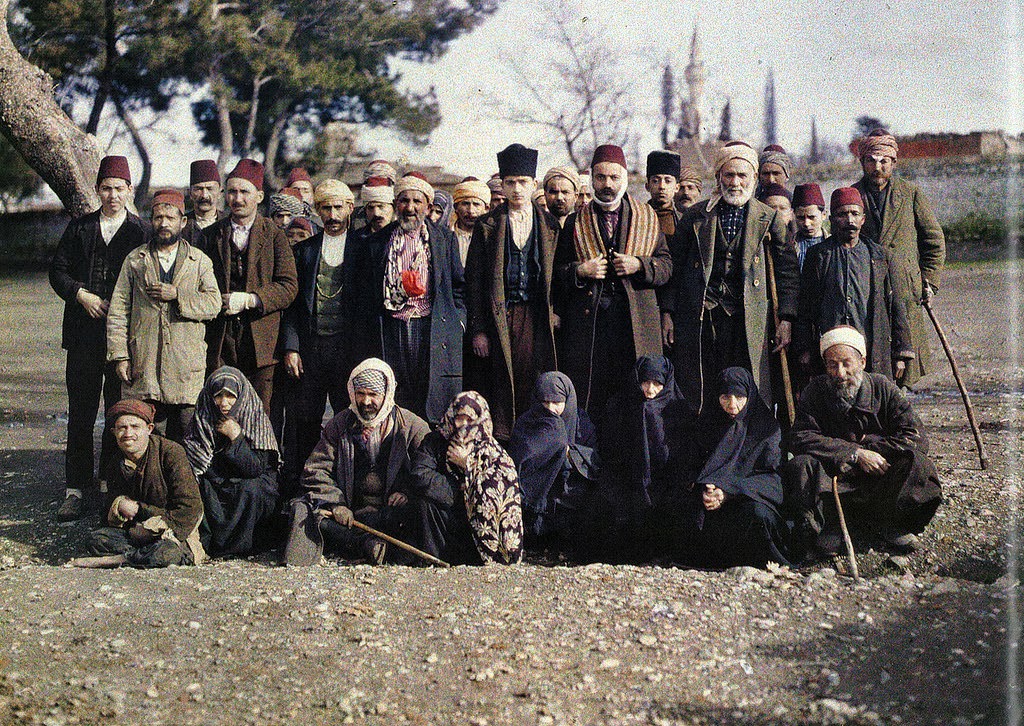
A gathered group stands on open ground in Manisa, arranged with the quiet formality of a community portrait. Men in fez and brimless caps crowd the back row in layered coats and vests, while several elders sit low in front with walking sticks, anchoring the scene with their steady presence. Women in dark, full coverings sit together at center, their posture reserved, creating a strong contrast against the lighter earth beneath them and the pale sky above.
Colorization brings a particular intimacy to the details: the deep reds of headwear, the muted browns and grays of wool, and the patterned textiles that break up otherwise plain garments. Faces read clearly—some meeting the camera directly, others glancing aside—suggesting a moment that is both staged and deeply ordinary. In the background, faint silhouettes of slender minarets rise beyond trees, hinting at the town’s skyline without drawing attention away from the people.
For anyone searching Turkish history through everyday life, “Turkish in Manisa” offers more than a simple group shot; it’s a small archive of clothing, age, and social presence in the late Ottoman or early Republican visual world. The mix of seated and standing figures, the variety of head coverings, and the rural edge-of-town setting evoke a society balanced between tradition and change. As a WordPress feature image or historical post, this colorized photograph makes Manisa feel immediate—less like a distant place on a map, and more like a living community paused for a single, enduring moment.