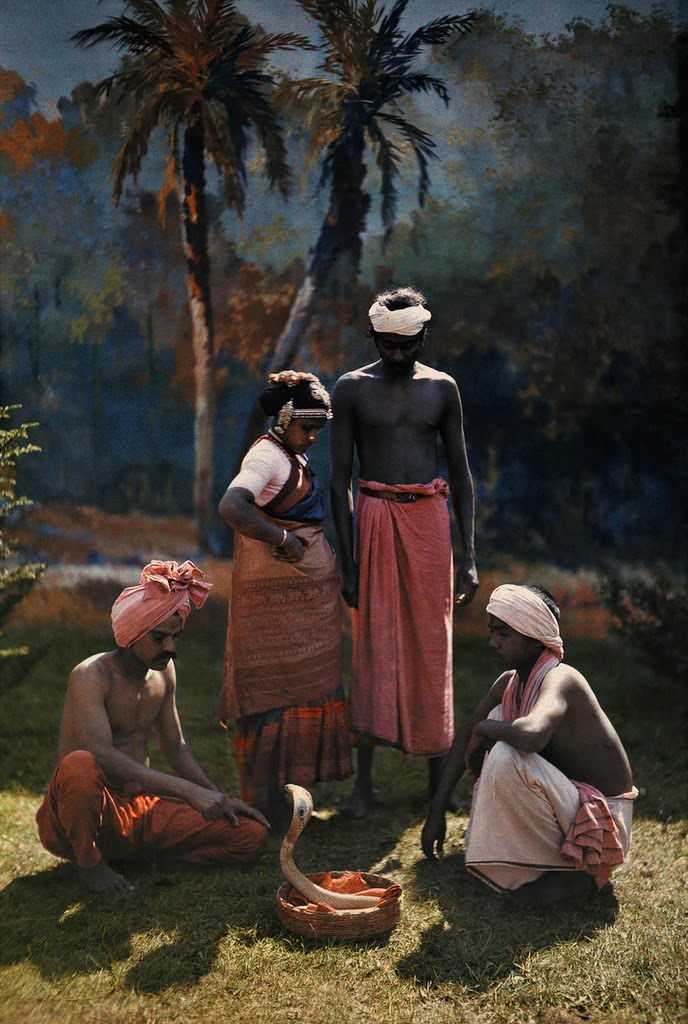
Under the shade of tall palms, a small circle of onlookers gathers around a woven basket where a cobra rises, hood flared, as if listening for a cue. The colorization lends warmth to the scene—earthy reds and dusty pinks in the wrapped garments, deep greens in the grass, and a muted, hazy backdrop that suggests a rural edge rather than a crowded street. Posture and spacing tell their own story: one man crouches close to the basket, another stands watchfully behind, and a third kneels with his attention fixed on the snake’s movement.
Snake charmers in India have long been photographed as symbols of folk performance, skill, and spectacle, yet the details here hint at a working routine more than a posed curiosity. The men’s headwraps and dhotis, the simple tools, and the careful distance kept from the cobra point to practiced handling and a shared understanding of risk. Even without the instrument visible, the moment evokes the well-known rhythm of a charmer’s act—control asserted through gesture, timing, and steady nerves.
For readers interested in Indian cultural history, colonial-era photography, or the art of modern colorization, this image offers a textured look at how everyday livelihoods were framed for the camera. It also invites a wider conversation about tradition and change, since snake charming has faced legal and ethical scrutiny in more recent times. As a historical photo brought back to life with color, it balances atmosphere and documentary value, making it a striking addition to any archive of vintage India and street performance traditions.