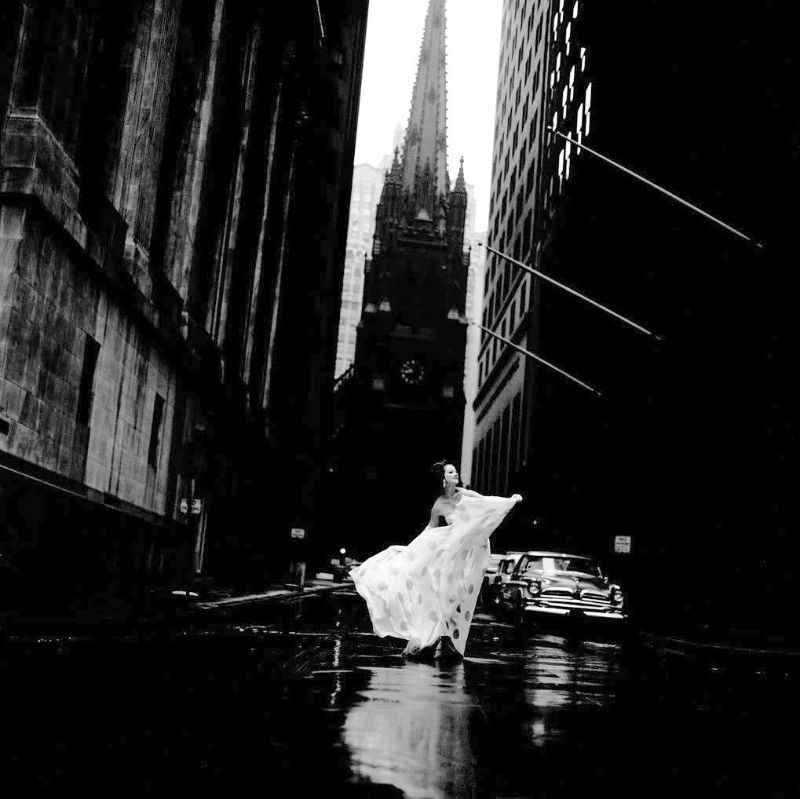
Against the canyon of Wall Street’s stone facades, Betsy Pickering stands like a bright flourish in motion, her light dress lifted and fanned out as if catching an invisible gust. The wet pavement turns the street into a mirror, doubling the drama of fabric and silhouette while deep shadows swallow the edges of the scene. A gothic church spire rises in the distance, its clock face faintly visible, lending the moment a sense of old-world grandeur amid modern towers.
Mid-century New York details anchor the fashion fantasy: a 1950s car waits at the curb, and the long perspective of the narrow street pulls the eye straight toward the dancer-like pose. The photograph plays with contrast—softness against steel, elegance against infrastructure—making the model’s movement feel almost defiant in a district better known for restraint and routine. Even without crowd noise, you can imagine the hush of early morning after rain, broken only by footsteps and the city’s slow waking.
Billed as “Betsy Pickering on Wall Street, 1958,” the image captures a classic collision of fashion and finance that made New York street photography such a powerful stage for style. It reads like an editorial still: a model transforming an everyday urban corridor into a runway, with architecture, reflections, and light doing as much storytelling as the clothing. For anyone searching mid-century fashion photography, 1950s New York style, or iconic Wall Street imagery, this frame distills the era’s confidence into a single sweeping gesture.