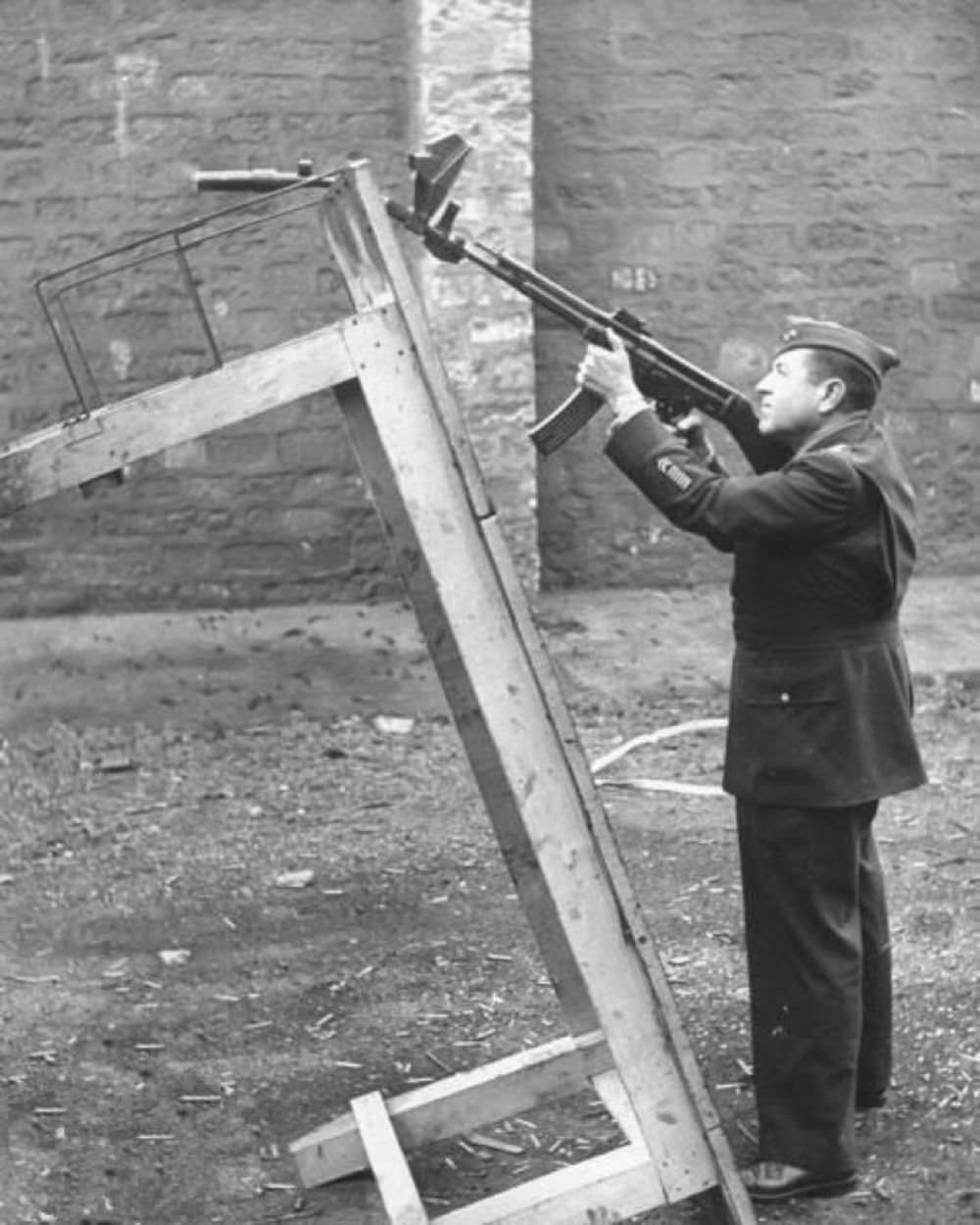
At a makeshift test range, a uniformed soldier raises a rifle fitted with an oddly bent attachment at the muzzle, aiming toward a simple wooden stand and wire-framed target. The setting feels improvised—brick wall behind, bare ground below—yet the experiment itself is audacious: an attempt to redirect gunfire without exposing the shooter. That strange curve hints at the wartime obsession with gaining an edge through engineering, even when the laws of physics were reluctant partners.
Krummlauf, the “curved barrel” concept associated with WWII-era German weapon development, promised a way to fire around corners from trenches, armored vehicles, or urban cover. The photograph’s focused posture and careful aim suggest controlled testing rather than battlefield use, the kind of trial where every shot mattered and every failure taught a lesson. In an age before compact cameras and modern sensors, even a rough rig like this could serve as a practical lab for evaluating recoil, accuracy, and the punishing stress placed on metal and ammunition.
What makes the story so compelling is how it sits at the crossroads of ingenuity and desperation, a signature of late-war inventions that chased bold solutions to immediate problems. “Bending Bullets in WWII” explores why such devices were pursued, how they were tested, and what their limitations revealed about materials, ballistics, and real-world combat conditions. For readers searching WWII inventions, experimental weapons, and the history behind the Krummlauf, this image offers a rare, grounded glimpse into the moment an improbable idea met the firing line.