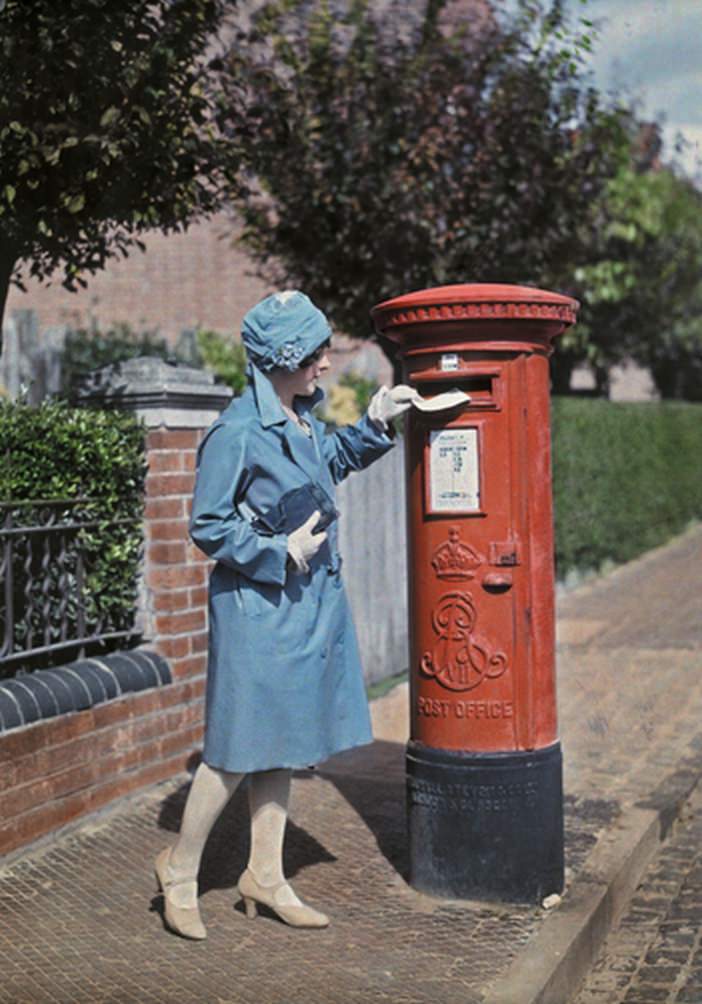
Outside a quiet Oxford street, a young woman pauses at a red pillar box, letter in hand, caught in that ordinary moment when private words enter the public world. The post box stands solid and official at the pavement’s edge, its painted surface and embossed insignia contrasting with the soft greens of hedges and trees behind her. Everyday errands rarely leave a trace, yet here the simple act of mailing a note becomes a small, vivid window into 1928.
Her clothing tells its own story about women’s everyday fashion in the late 1920s: a smart blue coat, a close-fitting hat, pale gloves, and heeled shoes chosen for walking city streets. The outfit feels practical but carefully coordinated, suggesting confidence and modernity without the need for spectacle. Framed beside brickwork and garden fencing, she looks like part of the neighborhood’s rhythm—moving between home, street, and the institutions that kept communication flowing.
Oxford in 1928 was a place where tradition and change lived side by side, and the pillar box serves as a familiar landmark in that landscape. Before email and instant messaging, the postal service shaped courtship, family life, work, and friendship, turning distances into something manageable with a stamp and a steady collection time. For readers drawn to fashion, culture, and social history, this photograph offers an intimate reminder of how style and daily routine met on the pavement, one letter at a time.