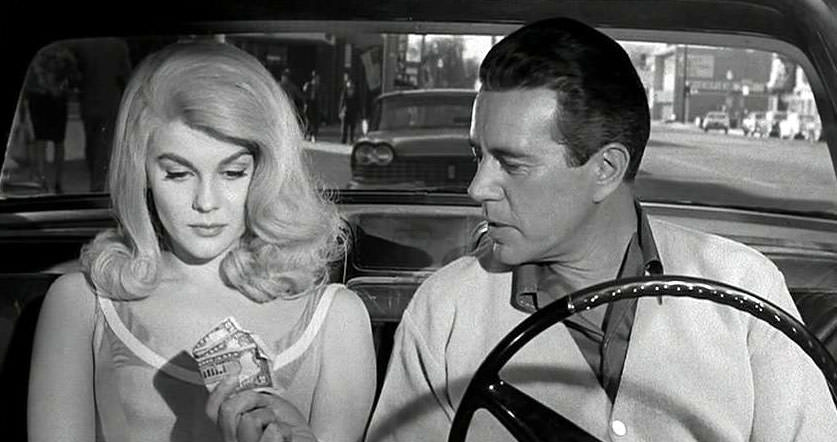
Inside a parked car framed by the windshield and dashboard, Ann-Margret sits with her gaze lowered, turning something small in her hands while John Forsythe studies her from the driver’s seat. The tight composition pulls the viewer into a private moment—close enough to feel the tension, yet distant enough to notice the ordinary street life beyond the glass. It’s a classic slice of 1960s cinema, where a quiet pause can hint at larger trouble.
Light and shadow do much of the storytelling here, modeling the actors’ faces in a stark black-and-white palette that feels both glamorous and uneasy. Her soft, carefully styled hair and sleeveless dress contrast with his controlled posture behind the steering wheel, suggesting a power imbalance that the scene refuses to resolve at a glance. The car becomes a stage set: enclosed, intimate, and loaded with unspoken stakes.
Fans searching for “Kitten with a Whip (1964)” will recognize the era’s blend of suspense and social edge, and this still captures that mood in a single, restrained beat. The background traffic and storefront shapes keep the moment grounded in everyday America, making the drama feel like it could spill into any street. As a piece of movie history, it’s also a reminder of how screen chemistry and careful framing could turn a simple conversation into a charged, unforgettable tableau.