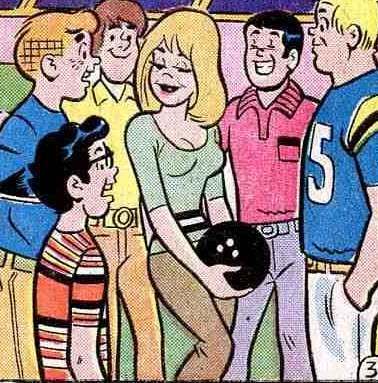
Archie’s clean-cut universe didn’t stay entirely buttoned-up as the decade shifted, and the artwork here hints at that sly change in tone. A smiling blonde at center stage cradles a bowling ball while a semicircle of Riverdale boys lean in with the wide-eyed attention that comics of the era often played for laughs. The bright, flat colors and thick ink lines signal classic Archie Comics style, but the body language and flirtatious framing nudge the gag toward something a little more suggestive.
Around her, familiar teen archetypes gather in a casual social scene that feels part bowling alley, part after-school hangout. One kid’s striped shirt and black hair evoke the bookish pal, while a blond athlete in a jersey marked with a bold “5” anchors the jock vibe. The group’s grins and glances do most of the storytelling, turning an ordinary prop into a wink at the “lusty pages” reputation some 1970s funny books flirted with.
For collectors and pop-culture historians, moments like this show how mainstream humor comics tested the boundaries of teen romance and cheeky innuendo without abandoning their wholesome brand. It’s a snapshot of how Archie art could dial up the heat through posture, wardrobe, and knowing expressions rather than explicit content. If you’re tracing the evolution of Archie Comics in the 1970s—especially the era’s playful, slightly spicier humor—this image fits right into that conversation.