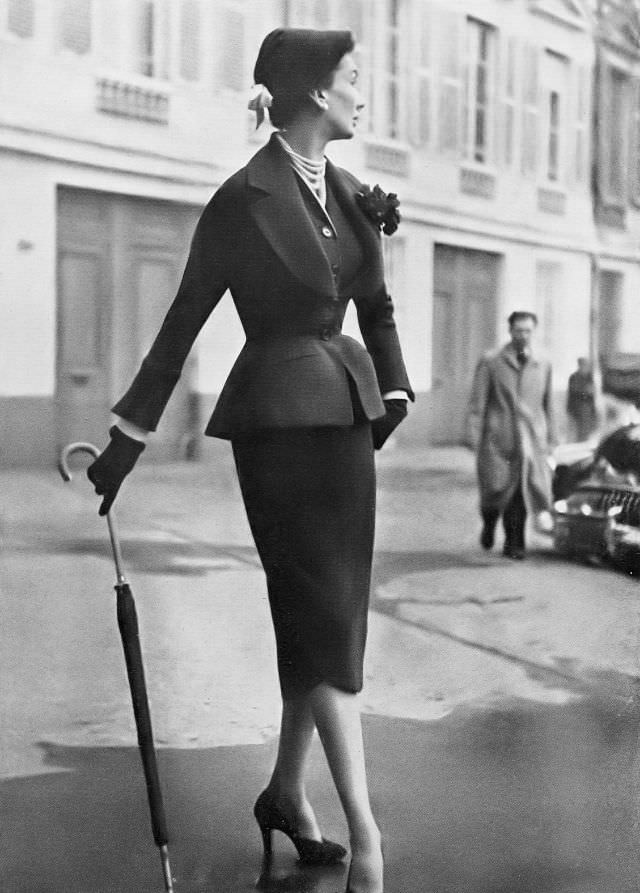
Poised in profile on a city street, Barbara Goalen turns her head as if catching a cue just out of frame, one gloved hand resting on a closed umbrella like a walking-stick. The fitted navy blue wool suit attributed to Christian Dior reads as pure mid-century control: a sharply tailored jacket with a sculpted waist and a horseshoe neckline, filled in with a matching vest that adds depth and polish. A small hat, pearls at the throat, and high heels complete the composed silhouette, while the blurred façades behind her keep the focus on line, balance, and attitude.
Dior’s 1950s tailoring is all about architecture, and the outfit’s details reward a closer look—especially the skirt described as two petal-shaped pieces, suggesting movement even in stillness. The jacket’s lapels and the cinched midsection create that celebrated hourglass form, yet the styling never feels fussy; it’s streamlined, urban, and self-assured. In this kind of fashion photography, elegance isn’t only the clothing but the stance: the elongated leg, the controlled turn of the shoulders, the way accessories echo the suit’s discipline.
Behind the model, everyday life carries on, with passersby and a parked car softened into a gentle haze, a reminder that couture once mingled with the street rather than floating in an abstract studio world. The contrast between Goalen’s precise silhouette and the casual background lends the image a documentary charm—high fashion meeting the postwar city. For anyone searching classic Dior, 1950 fashion, or the visual language of early supermodel culture, the photograph stands as a crisp lesson in how tailoring, posture, and setting combine to sell a dream.