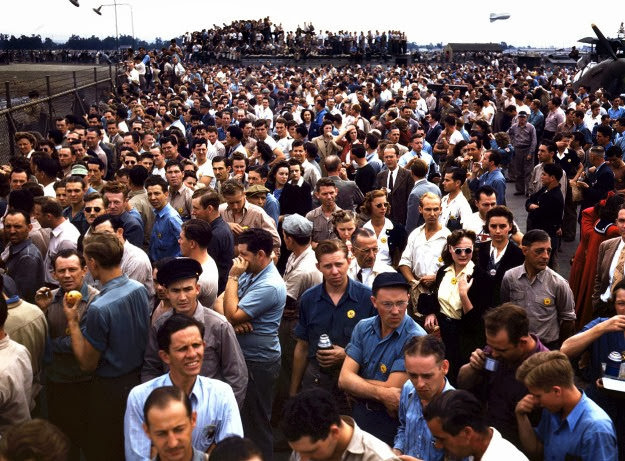
A dense sea of faces fills the frame at Consolidated Aircraft Corp. in Fort Worth, Texas, evoking the sheer scale of wartime production in 1942. The colorization brings out sunlit shirts, work caps, and factory badges, turning what might have been a distant moment into something immediate and crowded, like a shift change frozen in time. Every glance and posture hints at fatigue, urgency, and the steady rhythm of an industrial city mobilized for the air war.
Along the edges, the airfield setting becomes clearer: fencing, open ground, and the suggestion of aircraft nearby reinforce that these weren’t just factory hands—they were part of the assembly-line force behind Liberator bombers. The gathering feels informal yet purposeful, as if workers have paused between tasks or collected for an announcement, their attention split between one another and the activity beyond the camera. Small details—rolled sleeves, grease-darkened workwear, and varied uniforms—underscore how many different roles were required to keep the line moving.
For readers searching World War II home-front history, Fort Worth aircraft production, or Consolidated B-24 Liberator bomber manufacturing, this scene offers a powerful human counterpoint to the machines themselves. It reminds us that each aircraft represented not only engineering and materials, but also the coordination of thousands of workers whose names rarely made headlines. In color, the moment feels less like a relic and more like a living crowd—one chapter in the vast story of American wartime industry.