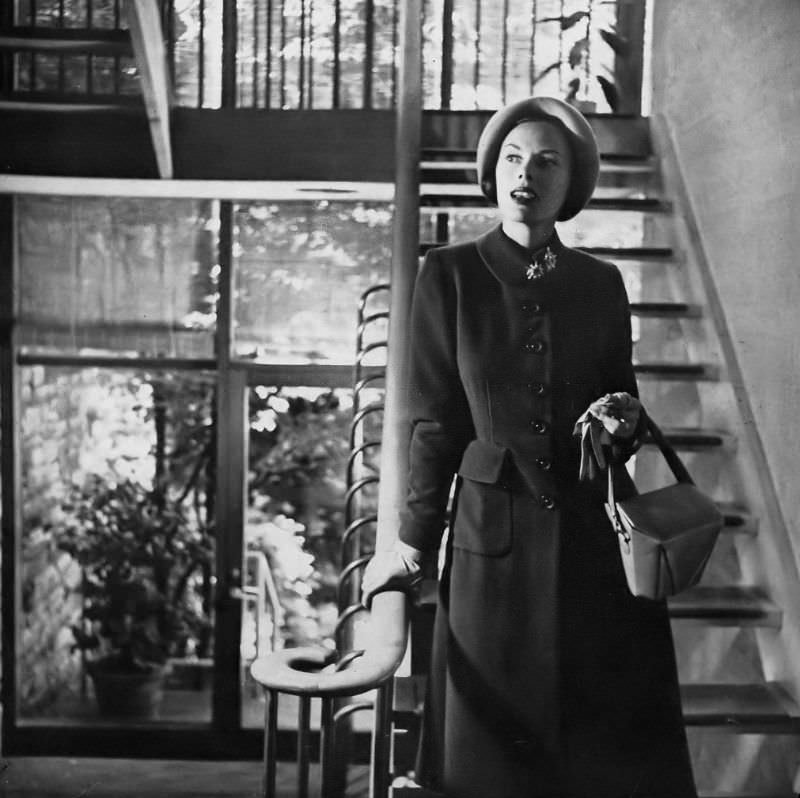
Poised beside a modern staircase, Meg Mundy wears a beautifully proportioned princess coat rendered in cocoa-brown Melton wool, its clean front fastenings emphasizing a long, uninterrupted line. Turn-back cuffs and flat pockets give the silhouette practical definition while still reading as unmistakably refined, the kind of postwar tailoring that balanced austerity with renewed elegance. A sculptural hat by Lilly Daché frames her face and heightens the look’s crisp formality, while a structured handbag completes the ensemble with polished restraint.
Behind her, tall panes of glass open the interior to a wooded view, letting daylight wash across the architecture and making the coat’s texture stand out even in monochrome. The setting feels deliberately contemporary—an airy room, spare furnishings, and a rhythmic run of stair rails—so the fashion reads as part of a larger story about modern living. Mundy’s turned gaze and slightly parted lips add motion and immediacy, as if she has paused mid-step on an errand that requires both warmth and style.
Published in Harper’s Bazaar in September 1947, the image also functioned as a persuasive piece of fashion communication: high couture sensibility translated into a home-sewing promise through Simplicity Pattern 2136. The princess cut—fitted through the torso and smoothly flaring below—signals the era’s return to shaped femininity, while the sturdy wool suggests garments made to last beyond a single season. For collectors of vintage fashion photography and mid-century style, it remains a memorable snapshot of how magazine editorial, pattern design, and accessories like a Daché hat converged to define late-1940s American chic.