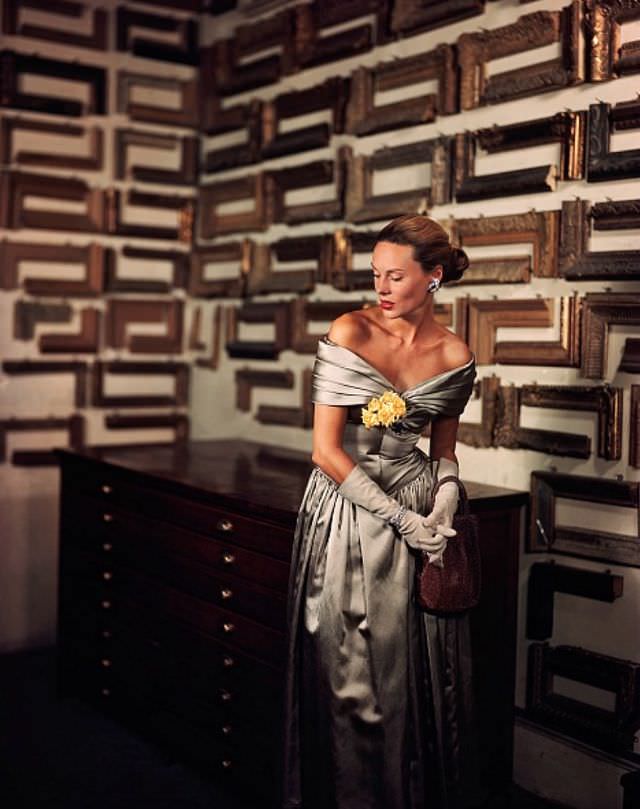
Poised against a wall crowded with empty, gilt-edged frames, Meg Mundy turns slightly away, her gaze lowered as if caught between entrances at an evening party. The setting feels like a gallery in transition—ornate borders without paintings—so the eye lands on the real centerpiece: the model’s sculptural silhouette and carefully lit face, rendered with the polished drama associated with mid-century fashion photography.
Silver satin pools and gleams across the dress, a reflective surface that makes every fold legible, from the fitted bodice to the long, fluid skirt. The shoulders are left bare, wrapped in a fichu of layered folds that reads like soft armor, while long gloves and a small handbag underline the formal, after-dark intention. A bright floral accent at the front punctuates the monochrome elegance, offering a focal point that plays against the cool sheen of the fabric.
Published in Harper’s Bazaar in November 1947 and credited to designer Jack Herzog, the image speaks to postwar couture’s renewed appetite for luxury materials and precise construction. Mundy’s controlled posture—hands gathered, head inclined—matches the era’s ideal of composed glamour, where restraint could look as striking as extravagance. For readers searching vintage fashion photography, 1940s eveningwear, or classic Harper’s Bazaar style, this portrait distills the period’s mix of modern editorial staging and timeless sophistication.