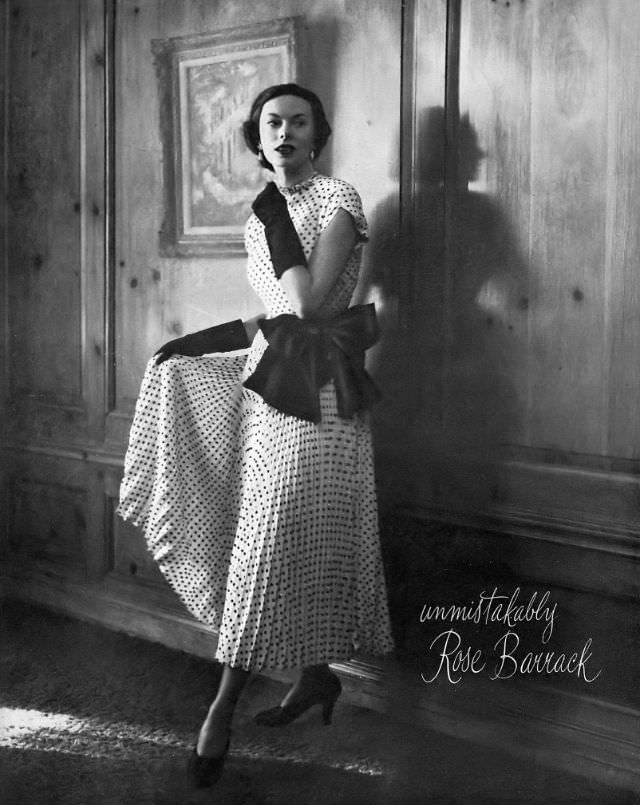
Poised against wood-paneled walls, Meg Mundy turns a fashion pose into a quiet scene of drama, her gaze steady as light and shadow play across the room. The setting feels deliberately restrained—plain paneling, a framed picture, and a soft carpeted floor—so the styling carries the story. Her silhouette reads immediately as late-1940s elegance: structured through the bodice, fluid through the skirt, and finished with gloves and heels that sharpen the overall line.
The dress itself, described in Harper’s Bazaar as black dotted silk entirely covered with sequins, creates a lively surface that would have flickered with every movement, even in monochrome. A full pleated skirt swings outward as she lifts it slightly, revealing the garment’s volume and crisp tailoring. At the waist, an oversized black bow anchors the look, a bold punctuation mark that balances sparkle with graphic simplicity.
Photographed by Rose Barrack for the February 1948 issue, the image sits at the intersection of fashion and culture, where couture-level craft met editorial storytelling. Mundy’s composed posture and the controlled interior backdrop emphasize the postwar appetite for polish—glamour presented as attainable, yet unmistakably aspirational. For anyone searching mid-century fashion photography, sequined eveningwear, or Harper’s Bazaar’s postwar aesthetic, this portrait remains a memorable study in texture, proportion, and modern poise.