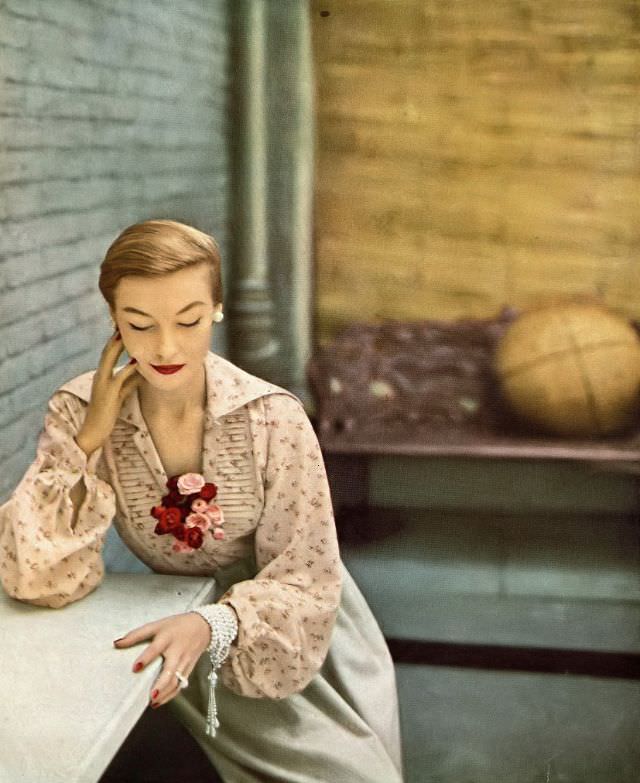
Poised at the edge of a pale tabletop, Liz Pringle turns inward for a quiet moment, her eyes lowered and one hand resting lightly at her cheek. Soft, studio-controlled color lends the scene a gentle warmth, while her sleek side-parted hair, pearl earrings, and vivid lipstick sharpen the look with mid-century polish. The composition feels deliberately intimate, inviting attention to posture and gesture as much as to the clothes themselves.
Her outfit—identified in the title as a skirt and blouse by Joset Walker for Harper’s Bazaar, November 1949—balances romance and structure in classic postwar fashion editorial style. A patterned blouse with a prominent collar and decorative front detailing frames a small cluster of floral accents, while the smooth skirt falls in a clean, elegant line. Accessories are kept refined: a sparkling bracelet, manicured nails, and restrained jewelry that underscores the ensemble’s ladylike sophistication.
Behind her, textured walls and a bench-like surface create a simple architectural backdrop, with a rounded object set off to the side like a quiet prop from the studio set. That pared-down environment makes the garments read clearly, the way magazine fashion photography often did—less about place, more about silhouette, fabric, and mood. As a piece of 1940s fashion history, the image echoes Harper’s Bazaar’s talent for merging couture sensibility with narrative calm, capturing a cultured vision of style in motion even at rest.