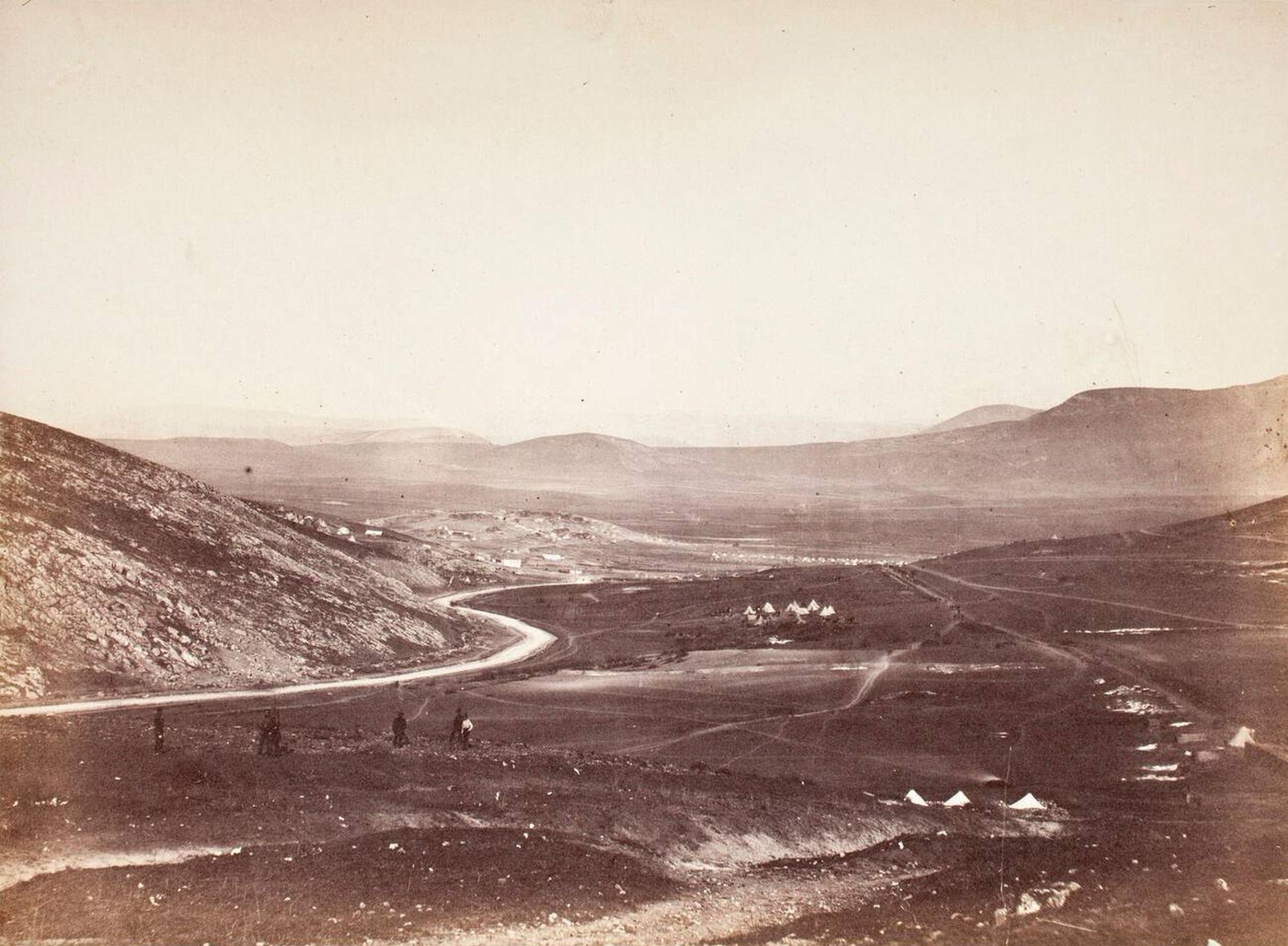
Across a wide, treeless valley, the land rolls out in pale bands of earth and shadow, with low hills rising in the distance and a winding road cutting a deliberate curve through the scene. Small clusters of tents sit lightly on the plain, their bright shapes emphasizing how exposed a military camp could be in open country. The title places us at Kadikoi in 1856, looking out from the Camp of Horse Artillery, where mobility and sightlines mattered as much as shelter.
Far from the drama of a charge or the thunder of guns, the photograph lingers on the quieter realities of war and military life: routes to be guarded, ground to be measured, and space to be organized into a temporary town. A few tiny figures near the roadway hint at scale, making the landscape feel even more immense, as if the terrain itself is the main character. For viewers interested in historical photography, the composition offers a striking example of how early cameras recorded not only people, but the strategic environments that shaped campaigns.
Kadikoi, from the Camp of Horse Artillery, 1856, invites a slower reading—one that notices the emptiness between tents, the starkness of the slopes, and the practical logic of placing camp near a traversable track. The soft tonal range and faint marks of age add to the sense of distance, like dust settling after movement has passed. As a piece of wars and military history, it serves as a visual reminder that endurance, logistics, and landscape were inseparable companions to every nineteenth-century army.