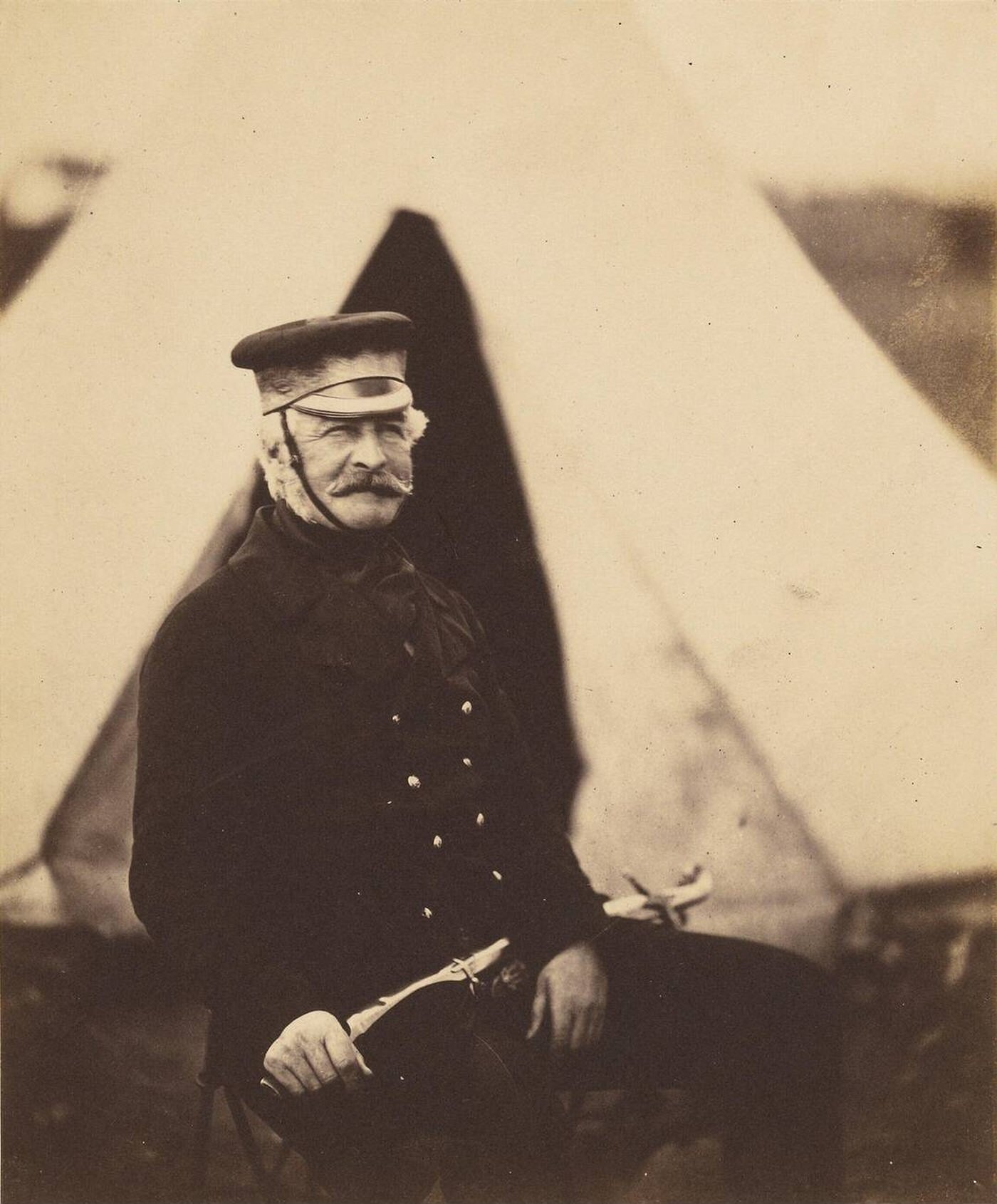
Lieutenant General Sir Richard England appears here in a formal mid-19th-century portrait, posed in uniform with a steady, appraising gaze. The dark coat is neatly fastened, the peaked cap sits squarely, and the hand resting near the sword hilt quietly signals authority without theatrics. Even through the soft focus of early photography, his prominent moustache and strong profile give the image a memorable character.
Behind him, canvas forms—likely tents—rise into pale, blurred shapes that suggest a temporary military setting rather than a studio interior. That contrast between crisp uniform details and the indistinct camp-like background evokes the lived reality of service: movement, logistics, and command carried out far from permanent quarters. The photograph’s restrained composition keeps attention on rank, bearing, and the material culture of the era’s armed forces.
For readers interested in wars and military history, this 1855 portrait offers a tangible connection to how senior officers were documented and presented to the public. It also serves as a small window into period photography, where exposure times and outdoor light could lend portraits a calm, contemplative atmosphere. As an artifact, it balances biography and battlefield context—an enduring record of a commander’s image in a century shaped by conflict and reform.