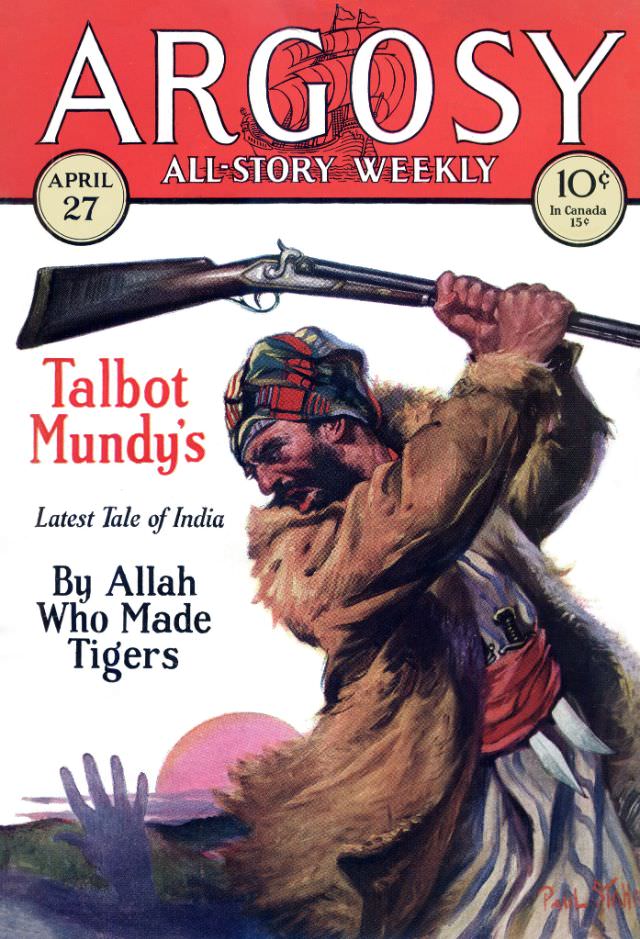
Bold red lettering crowns the April 27, 1929 issue of *Argosy All-Story Weekly*, framing a dramatic slice of pulp-era imagination. The cover art thrusts a turbaned figure into the foreground, arms raised as he swings a long gun like a club, his fur-trimmed coat and patterned garments rendered with painterly texture and motion. Behind him, a low sun glows near the horizon, heightening the sense of danger and urgency that magazine racks once relied on to stop passersby in their tracks.
Talbot Mundy’s name anchors the narrative promise on the page, paired with the line “Latest Tale of India” and the striking title “By Allah Who Made Tigers.” The typography, layout, and price circles—“April 27” on one side and “10¢” with a Canadian price note on the other—make the cover as much an artifact of publishing history as an illustration. It’s a snapshot of how adventure fiction was marketed in the late 1920s: exoticized settings, peril in mid-action, and a headline designed to ignite curiosity.
Collectors and researchers of vintage magazine covers will recognize the careful balance between visual storytelling and salesmanship that defined *Argosy* at its peak. From the oversized masthead to the intense, almost theatrical pose of the central figure, every element is tuned for impact, reflecting the era’s appetite for serialized thrills and far-flung escapades. Whether you’re studying pulp illustration, early 20th-century print culture, or the evolution of popular adventure writing, this *Argosy* cover offers a vivid, searchable window into 1929’s newsstand allure.