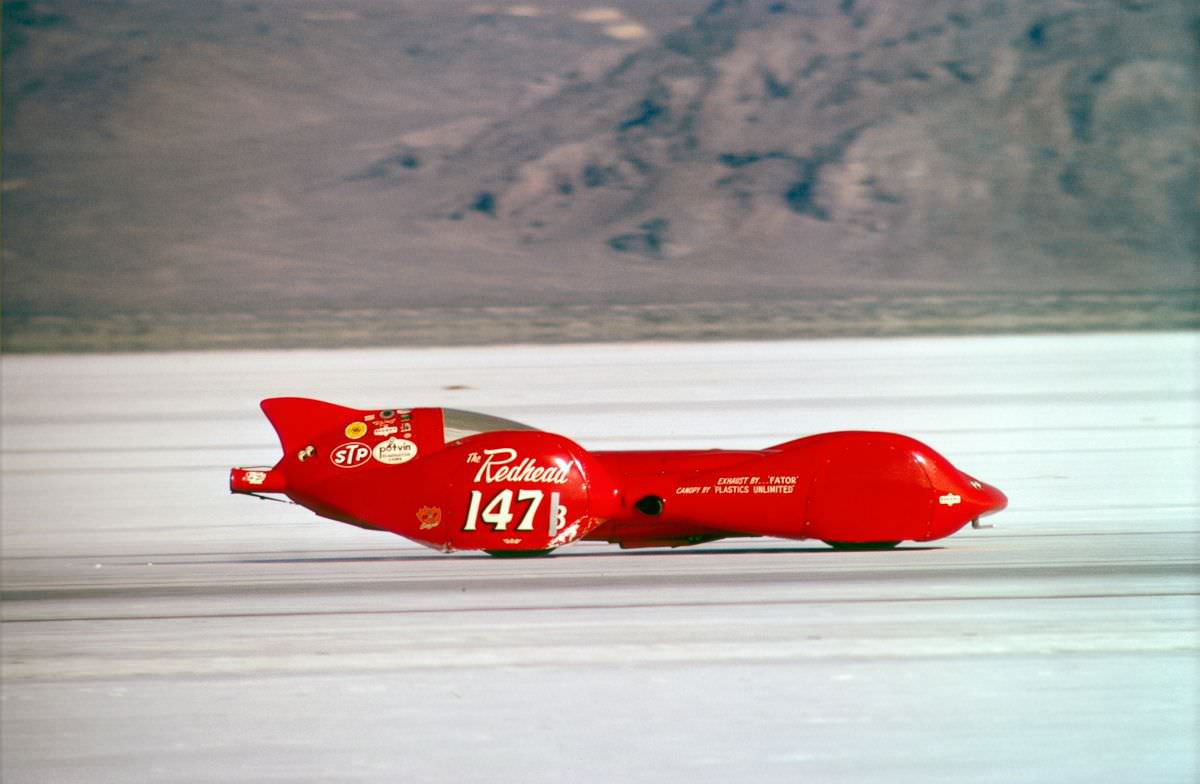
Across the blinding expanse of the Bonneville Salt Flats, the Hammon‑McGrath‑Appenfels “Redhead” streamliner #147B cuts a razor-straight line, its long, low body painted a vivid red against the pale track. Sponsor decals cluster near the tail, while the bold “Redhead” script and race number anchor the car’s identity in mid-run. In the distance, muted mountains frame the scene, emphasizing how much of land-speed racing is about isolation, horizon, and nerve.
Built for one purpose—maximum speed with minimum drag—the streamliner’s smooth, enclosed shape reads like aircraft logic applied to wheels. The tiny cockpit opening and tapered nose suggest a machine designed to slip through air rather than fight it, turning the salt surface into a temporary runway. That contrast between sleek engineering and the raw, open landscape is what makes Bonneville imagery so enduring for motorsport historians and automotive photography collectors.
The title’s claim of a 331.46 mph class-trophy run gives the photograph its punchline: this isn’t merely a posed moment, but a record-minded pass in the world of land speed racing. For anyone searching Bonneville Salt Flats Speed Trials history, streamliner racing, or the “Redhead” #147B, the scene captures the era’s mix of ambition and ingenuity—teams betting everything on a few miles of salt and a handful of heartbeats at full throttle.