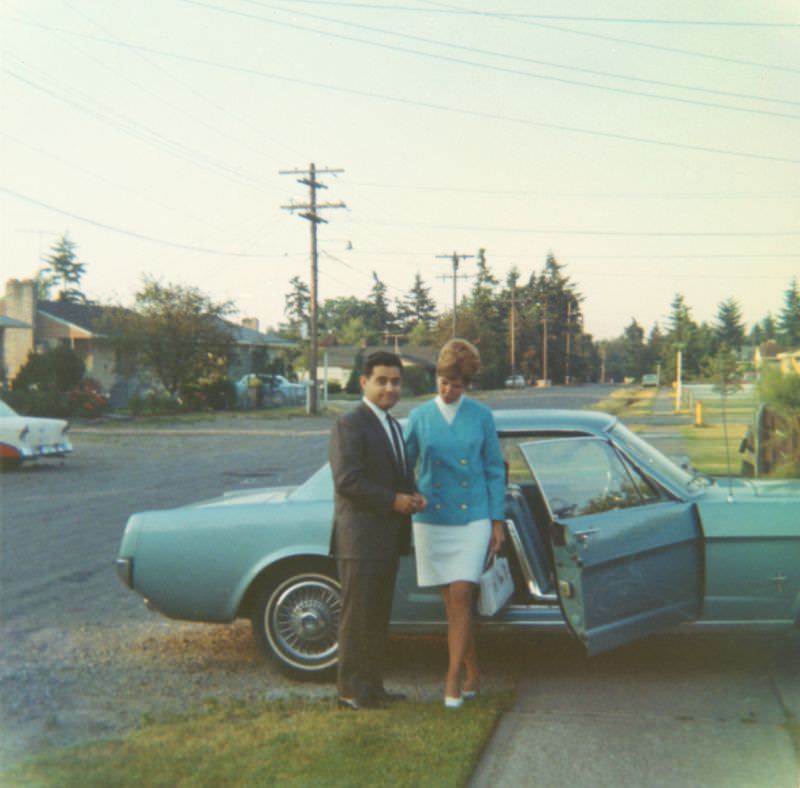
Sunlit and slightly faded, the scene unfolds on a quiet suburban street where a couple pauses beside a gleaming mid-century car with its door swung open. The neighborhood details—low houses, telephone poles, and a broad, empty roadway—place the moment firmly in the postwar world of North American everyday life, when personal style and modern mobility went hand in hand. There’s an unspoken sense of anticipation, as if they’ve just arrived for an evening out or are about to step into a special occasion.
Attention naturally drifts to the woman’s hair, arranged into a tall, sculpted beehive that crowns her look with unmistakable 1960s confidence. Paired with a neat, tailored outfit and a small handbag, the hairstyle reads as both fashionable and deliberate, the kind of statement built with teasing, pins, and plenty of hairspray. Even without a formal studio setting, the beehive turns an ordinary curbside moment into a snapshot of era-defining glamour.
Alongside her, the man’s dark suit and narrow tie echo the decade’s clean, modern silhouettes, suggesting how fashion and culture were converging toward sleek simplicity with a hint of youthful edge. The car—polished, low-slung, and proudly present—adds another layer of period authenticity, linking the iconic hairstyle to the broader aesthetic of 1960s design. Taken together, the photo serves as a warm reminder that trends like the beehive weren’t only seen in magazines and salons; they lived in driveways, on sidewalks, and in the small rituals of going out.