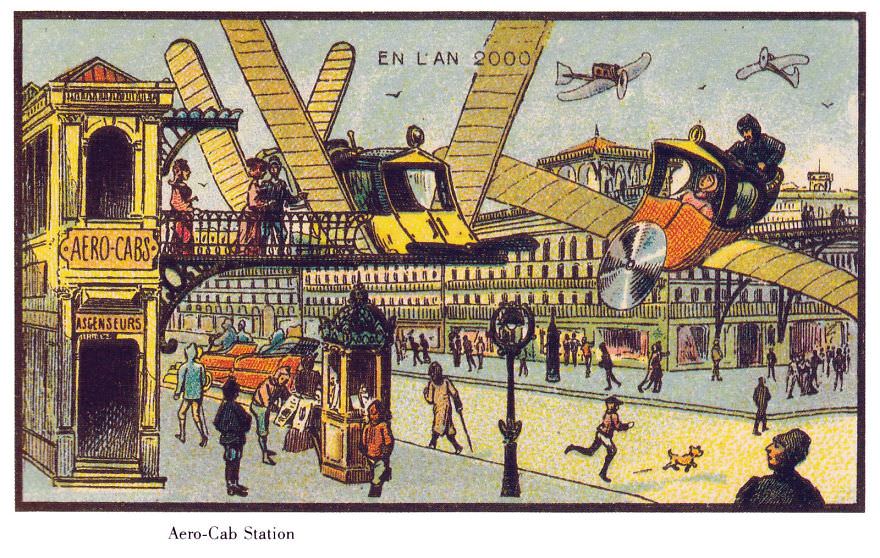
A bustling “Aero-Cab Station” rises beside ornate city architecture, complete with a bold AERO-CABS sign and an entrance marked “ASCENSEURS,” as if hailing a flight were as ordinary as stepping into a lift. Above the street, small taxi-like aircraft hover and glide, their broad wings slicing across the skyline while people below continue their errands, seemingly unfazed by the spectacle overhead. The captioned promise “EN L’AN 2000” signals a playful leap into a future imagined from an earlier era.
What makes this scene so funny—and so revealing—is how confidently it treats air travel as everyday public transport. A uniformed figure rides with a passenger in a bright little craft, pedestrians cross open plazas, and even a dog darts along the pavement, grounding the fantasy in familiar street life. The artist folds futuristic technology into the rhythms of the city: kiosks, lampposts, crowds, and a station façade that feels more like a transit hub than a marvel.
For anyone searching for early “future city” art, retrofuturism, or whimsical predictions of flying taxis, “Aero-cabs” offers a charming window into past optimism. It’s less about technical realism than about the dream of convenience—sky lanes replacing traffic jams, stations making flight routine, and modern life continuing under a canopy of wings. Viewed today, it reads as a spirited historical commentary on how every generation sketches tomorrow using the streets it already knows.