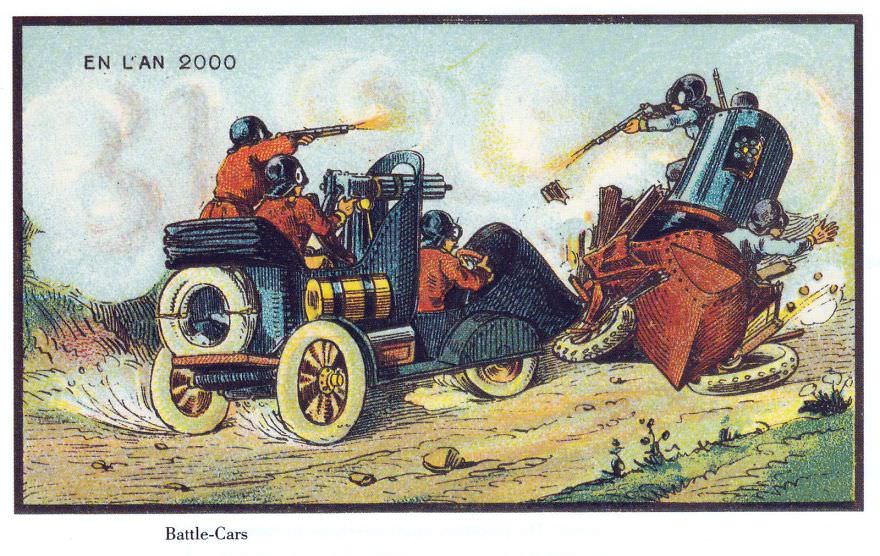
A riot of “future warfare” unfolds in this colorful illustration labeled “EN L’AN 2000,” where early-automobile styling collides with battlefield fantasy. A small open car, all spoked wheels and exposed machinery, races along a rough country track while helmeted figures fire rifles from the seats. The sense of speed is heightened by the dust and motion lines, turning what looks like a casual drive into a rolling skirmish.
On the right, an opposing contraption tips and buckles, its tank-like bodywork and treads pitching upward as debris flies. The artist revels in the absurd engineering: oversized armor plates, a boxy turret-like housing, and weaponry used as casually as accessories. It’s the kind of exaggerated, comic-book brutality that makes the “Mad Max Battle-cars” title feel surprisingly apt, even though the visual language is closer to turn-of-the-century optimism than modern dystopia.
What makes this piece so entertaining—and so useful for anyone interested in retrofuturism—is how it mirrors its era’s fascination with the automobile as both marvel and menace. The caption “Battle-Cars” reads like a confident prediction, suggesting that tomorrow’s conflicts would be fought by mechanized adventurers on wheels. Funny, yes, but also revealing: it’s a snapshot of how people imagined technology reshaping daily life, warfare, and spectacle in the year 2000.