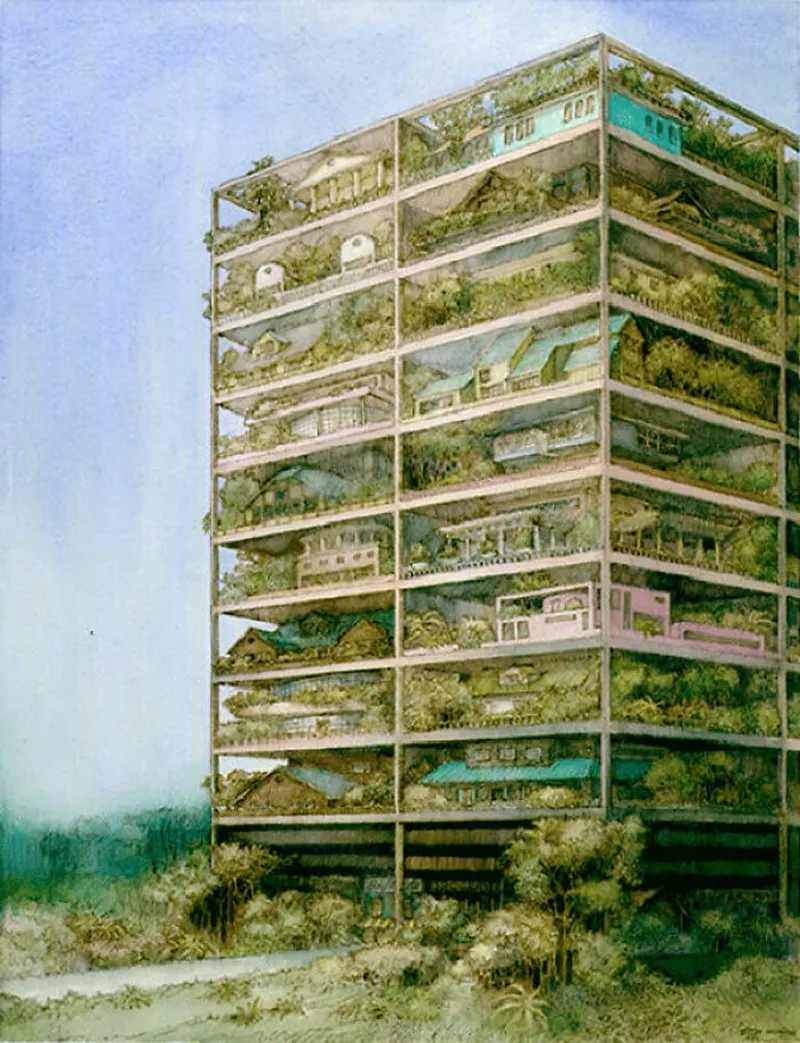
A tall concrete frame rises like an apartment tower, yet every floor is laid out as if it were its own little neighborhood. Behind the open grid sit miniature houses, porches, and winding lanes, with greenery spilling out in thick patches that soften the hard edges. The effect is funny at first glance—suburbia stacked and shelved—but it also reads as a pointed 1981-era thought experiment about what happens when the horizontal sprawl runs out of land.
Look closer and the logic of the satire becomes clearer: each tier promises the familiar comforts of a detached home, only now compressed into a vertical cross-section. Trees and shrubs push up against railings, roofs peek from behind hedges, and tiny yards appear to have been squeezed into places meant for corridors. It’s a whimsical “suburban high-rise” that turns the American dream of space into a carefully rationed commodity.
As a piece of retro futurism, the scene captures anxieties about growth, density, and the environmental limits of endless expansion, while still keeping a playful tone. The illustration invites modern readers to compare its stacked cul-de-sacs to today’s debates over housing shortages, suburban development, and greener urban planning. For anyone interested in 1980s visions of the future, this image is a memorable reminder that comedy often carries the sharpest critique.