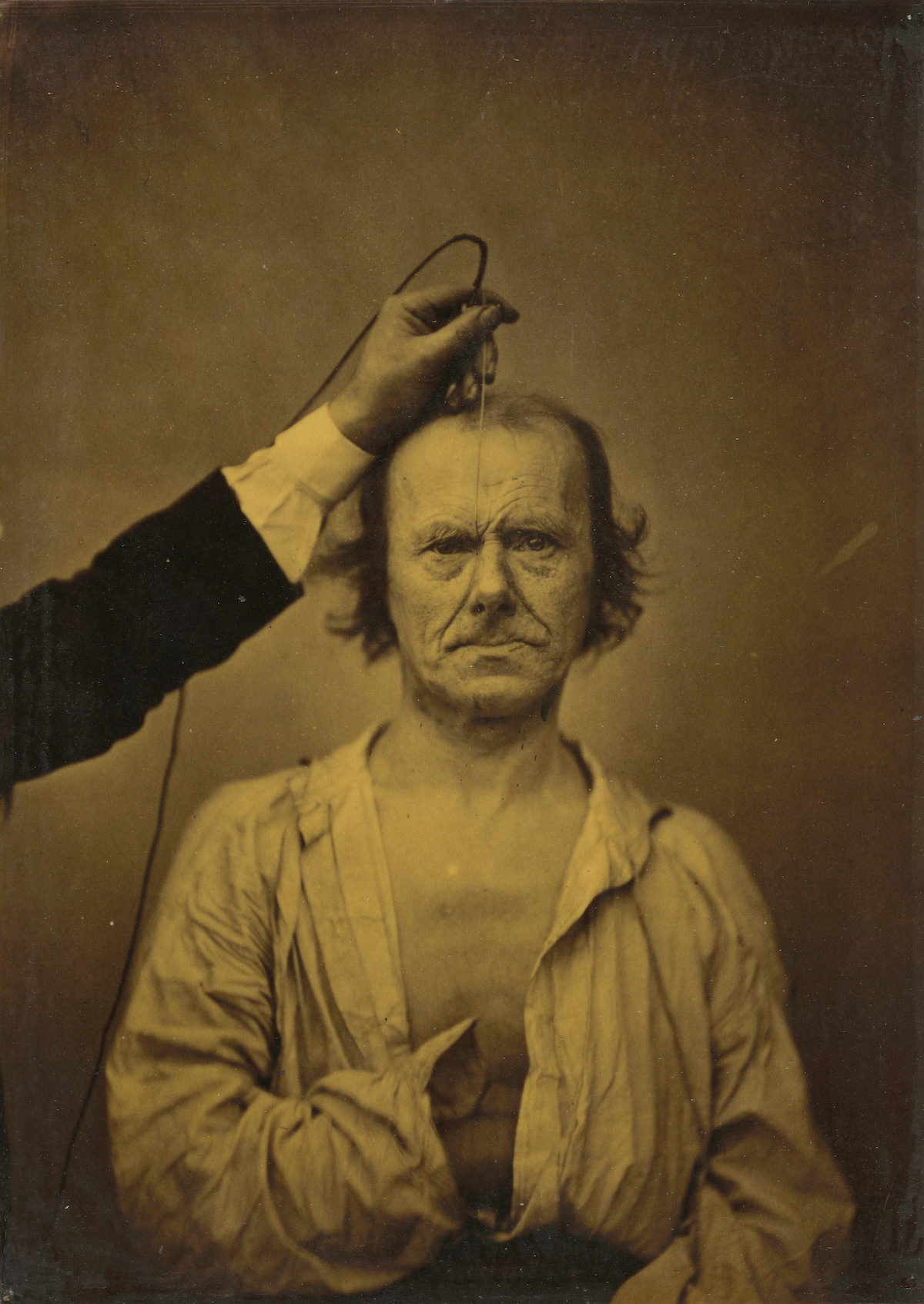
A taut string hangs in front of a man’s face while an unseen hand, cuffed in a dark sleeve, holds it aloft like a measuring tool. The sitter’s shoulders slump inside a loose, rumpled shirt, yet his gaze meets the viewer with a wary steadiness, as if bracing for instruction. Warm sepia tones and soft studio lighting give the scene an intimate, clinical stillness that suits the title’s split focus: “Attention (left); Severity, aggression (right).”
Rather than flattering portraiture, the composition feels like a demonstration—an artwork rooted in observation and classification, where posture, expression, and the geometry of a face become evidence. The string acts as a visual plumb line, inviting the eye to compare one side to the other and to read character in asymmetry. Even without any printed caption in the frame, the setup suggests the period fascination with physiognomy, temperament, and the idea that emotion could be mapped onto features.
For modern viewers, the photograph’s power lies in that tension between human vulnerability and the authority of measurement. It’s easy to linger on the man’s lined forehead and tight mouth, then notice how the hand and string quietly dominate the top of the image, turning a person into a specimen. As a historical photo and artwork study of expression, it’s an evocative piece for readers interested in early photographic practices, portrait psychology, and the uneasy history of “scientific” visual judgment.